Ordering Acrylic Paint for a Classroom or Studio: A Step-by-Step Buyer's Checklist
-
Step 1: Calculate Your Usage Before You Open a Catalog
-
Step 2: Choose the Right Paint Format
-
Step 3: Order the Mediums at the Same Time
-
Step 4: Do the Coverage Math (Yes, Really)
-
Step 5: Verify Safety Labels
-
Step 6: Don't Forget the Supporting Supplies
-
Step 7: Place the Order and Verify Every Detail
- Common Mistakes That Cost You Time and Money
-
The Bottom Line
If you're in charge of ordering acrylic paint for a school or studio, you probably already know that “just get some paint” isn't the whole story.
I coordinate art supply purchasing for a district with 12 schools, and I've been doing this since 2021. That puts me in a weird spot: I'm not an artist, but I've learned enough about acrylic paint to know what teachers actually need. This checklist is the result of three years of trial and error — and honestly, plenty of errors.
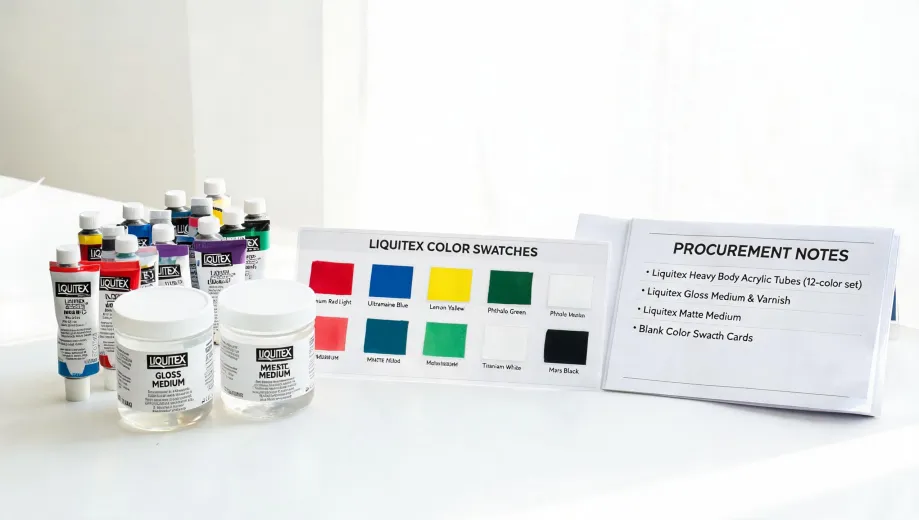
Here's my step-by-step process for ordering Liquitex heavy body acrylic and everything that goes with it.
Step 1: Calculate Your Usage Before You Open a Catalog
Most buyers start with the price list. I get it, I used to do the same thing. But you need to start with your numbers: how many students, how many projects, how many class sessions per semester.
For a class of 25 students doing one acrylic painting per week, you'll need roughly 10–15 ml of heavy body acrylic per student per session, assuming it's mixed with a medium. That works out to about one 22 ml tube per student per project. If you're buying for younger grades (K–8), add 20% to that estimate — kids go through paint faster than high schoolers or adults, probably because they're still figuring out how much to squeeze out.
This is where I use a plain desktop calculator. I've got one of those gold calculator models that's been on my desk for years, the kind that just sits there and does basic arithmetic. I plug in class size, sessions, and average paint use per student, and I get a per-program number that I can actually defend in a budget meeting. Sounds basic, but I can't tell you how many orders I've seen that were based on someone's gut feel — not on usage data.
Step 2: Choose the Right Paint Format
Acrylic paint comes in different consistencies, and they're not interchangeable. If you're ordering on behalf of an art teacher, this matters more than the brand.
Heavy body acrylic is thick, holds brushstrokes, and behaves like a classic oil paint. It's the best all-around choice for classroom use because students can layer it, blend it, and use palette knives without it turning into a runny mess. Liquitex heavy body acrylic is my default pick for every school in our district.
Soft body acrylic feels more like thick cream. It's good for glazing and mixing, but it can feel slippery to beginners who expect some resistance from the brush. I order this only when a teacher specifically requests it.
Fluid acrylic is pourable and used for wash techniques or airbrushing. It has its place, but not in a general classroom order.
One more option: the cheaper basic lines. Liquitex has one, and honestly, it performs fine for K–8 classrooms. But once you get to high school students trying to mix specific colors and control opacity, the professional heavy body line shows a real difference. The pigment load is higher, so the paint actually covers the surface the way students expect. In my opinion, it's worth the upgrade if your budget allows.
Step 3: Order the Mediums at the Same Time
This is the step that trips up almost every first-time buyer. You order paint, you think you're done, and then the teacher asks for “medium” and you don't know what that is.
Mediums are additives that change how acrylic paint behaves. They can extend the paint, change its finish, or alter drying time. The ones I order every single time:
- Liquitex acrylic satin medium — extends paint coverage without diluting color, adds flexibility to the dried film, and leaves a satin finish. Teachers love it because student work displays well and the paint doesn't feel like plastic when it dries.
- Gesso — a primer you apply to canvas before painting. It seals the surface so the paint doesn't soak through.
- Varnish — a protective topcoat for finished work that will be handled, shipped, or exhibited.
In 2022, I placed three separate rush orders because I kept forgetting the gesso and varnish. Rush shipping on a 10-pound package is not cheap, and I still kick myself for not bundling everything into one purchase. Now I make a list of mediums in the same document as the paint order, before I even look at vendors.
Step 4: Do the Coverage Math (Yes, Really)
Here's the part nobody warns you about: you have to calculate how much surface area the students will be covering. Paint coverage determines how much you order, and it's a step most buyers skip entirely.
A standard 16×20 inch canvas is about 2.2 square feet. A student painting typically gets three to four layers. Heavy body professional acrylic covers roughly 400–500 square feet per gallon at a normal painting thickness. Medium extends that further.
Let me rephrase that in a more practical way: if a class of 25 students is painting on 16×20 canvases once a week for a semester, you'll need about one gallon of heavy body acrylic per 10–12 students. That's 2.5 gallons for the full class. Gesso is separate: roughly one pint covers about 10 pre-primed canvases.
If you're building custom canvas frames or wooden panels, a board foot calculator will help you order the right amount of lumber without guesswork. A board foot is a lumber measurement that catches everyone off guard. A 1×2 inch piece of wood that's 8 feet long is about 1.33 board feet. Multiply that by the number of frames and you'll know exactly what to ask for at the hardware store.
The point is: do this math before you order, not after. I use my calculator for every estimate. It's tedious, but it beats explaining to a budget manager why we need a $600 emergency order in November.
Step 5: Verify Safety Labels
This one is non-negotiable for K–12 schools.
Liquitex markets some of its acrylics as cadmium-free, which is a good start. But “cadmium-free” doesn't automatically mean “safe for children.” Some pigments contain other heavy metals like cobalt or manganese.
Under the Labeling of Hazardous Art Materials Act (LHAMA), all art materials sold in the US must conform to ASTM D-4236. This standard requires that the product's label disclose any potential chronic health hazards.
If you see ASTM D-4236 on the label, the product has been reviewed by a toxicologist. For elementary classrooms, choose colors specifically labeled non-toxic. For high school and above, cadmium-free is a reasonable baseline — but check the pigment information anyway, especially for student-use products.
Step 6: Don't Forget the Supporting Supplies
Brushes, palettes, paper, rags, water cups. These sound obvious, but more than one shipment has arrived at our district without them.
One less obvious item: protractors. I know it sounds random, but art teachers often incorporate geometric pattern design and perspective drawing into their lessons — especially in STEAM programs. If you're wondering how to use a protractor, the short answer is: you line up the center point on the angle's vertex and read where the other line crosses the degree scale. It's a basic geometry tool, but it's also genuinely useful in art classrooms for drafting accurate angles.
I started asking teachers about these add-ons before each order, and now protractors are on every requisition list. It costs almost nothing to include them, and it saves a trip to the office supply store mid-semester.
This is also where the budget starts to feel real. Brushes and palettes are the kind of consumables that add up. But they're what make a classroom functional. I factor them into every order now instead of treating them as an afterthought.
Step 7: Place the Order and Verify Every Detail
When I'm ready to commit, I run through a quick audit:
- SKUs are correct. Liquitex heavy body acrylic comes in 22 ml, 59 ml, 118 ml, and 237 ml tubes — it's easy to select the wrong size when you're ordering 40 colors at once.
- Delivery date confirmed in writing. A verbal promise disappears fast when a supplier misses a deadline.
- The vendor issues proper invoices. I got burned in 2023 when a vendor only sent a handwritten receipt and our finance team rejected the entire report. That was a $2,400 lesson.
- There's a return policy for damaged goods. Paint can freeze in transit or arrive with broken caps. If you don't inspect it within the return window, you own it.
Also, plan the delivery location. An order of 25 pounds of paint, medium, and gesso is heavy, and it needs to be stored in a climate-controlled space. Acrylic paint that freezes in a loading bay can be ruined permanently.
Common Mistakes That Cost You Time and Money
Mistake 1: Buying the cheapest acrylic you can find
Low-cost paint has less pigment and more filler. Students get frustrated when the color doesn't cover, so they apply more, and then the paint cracks as it dries. You're not saving money if the teacher has to supplement the order with their own supplies.
Mistake 2: Underestimating delivery logistics
Paint is heavy. I've seen orders sit in a school loading area for three days because no one had a cart to move them. In winter, that's a loss. Schedule the delivery date with the school office and confirm someone will be on site.
Mistake 3: Treating all acrylic paint orders the same
One viscosity doesn't fit every class. Heavy body and soft body behave differently, and what works for an AP art class won't work for a first-grade after-school program. Ask the teacher what they're planning to teach, then order for that.
The Bottom Line
Ordering acrylic paint for a classroom isn't difficult, but it rewards you for being deliberate. Start with usage numbers, pick the right format, include the mediums, calculate coverage, verify safety compliance, and don't forget the small supplies.
If you spend 15 minutes with a calculator before placing the order, you'll avoid a semester of headaches. I know because I've made most of these mistakes myself — and the teachers I order for deserve better than my worst first-year guesses.

Elena Baptista
Elena Baptista is an office printing and imaging analyst covering laser and inkjet printers, multifunction devices, copiers, label and receipt printers, ink cartridges, toner cartridges, and drum units. She applies ISO/IEC 24734, ISO/IEC 24711, and ISO/IEC 19798 methods while comparing print speed, first-page time, duplex throughput, duty cycle, page yield, coverage assumptions, resolution, color consistency, energy use, and maintenance intervals. Her guides help offices, schools, dealers, and procurement teams match output volume, media handling, connectivity, consumable economics, service access, and fleet-management requirements.