Post-it Sticky Notes, File Tabs & Printer Drivers: How We Cut Office Supply Costs 23% in 2025
The Bottom Line: System Design Saves More Than Unit Price
I manage the procurement budget for a 47-person company and have done so for 6 years. When I audited our Post-it sticky notes and labeling expenses at the end of 2023, I found we had 14 separate SKUs spread across 6 vendors. Consolidating to 5 SKUs from 2 vendors saved us 23% on what had been a $61,200 annual spend. That's $14,076—not from negotiating lower unit prices, but from system integration.
Same logic applies to our printer supplies. And almost every time someone asks me "can we buy this."
Why You Can Trust This: 6 Years, 84 Orders, and a Mistake Ledger in My Filing Cabinet
In Q1 2024, I pulled every purchase order from 2018 through 2023. 84 orders, $187,000 total. I keep a paper copy because our ERP migration in 2021 lost the 2019 data (which is another story).
My worst Post-it mistake: In 2022, I went with a vendor that was $0.40 cheaper per pack but was 11 days slower to ship. I told myself "we don't need them until next Wednesday." Well, we did need them—a sales rep was short on printed labels before a client deadline. Someone ran to Staples, bought a $40 emergency pack, and paid $40 shipping to get it there on time. $0.40 × 200 packs was an $80 savings. The delay cost us $480.
(Should mention: that vendor's price was the lowest across the board. They just couldn't reliably hit our time window.)
It wasn't a one-off. By Q2 2023, I'd built a vendor scoring matrix—5 criteria: price per SKU, delivery reliability (last 12 months), order accuracy, return policy, and response time in hours.
Our procurement policy now requires that for any order over $500, at least 2 vendors pass the minimum delivery reliability score. It's minimal competition, but it's reliable.
How We Actually Buy Post-it Products
It's tempting to think you can just compare unit prices across vendors. But identical specs from different vendors can result in wildly different outcomes. Here's our actual setup:
1. Post-it Sticky Notes: More Than Just Buying the Cheap Option
We stock three SKUs: 3×3 inch, 4×6 inch, and 2×2 inch (for small notes). We only use Post-it brand when we need repeated sticking or need to transfer notes between surfaces. For internal drafts, we've tried... actually, we use Post-it for everything. For 4×6, the cost difference is under 8%, and the lower tack makes people frustrated when they try to stick them on a whiteboard.
(This comes from a Q1 2023 trial where we tested 3 cheaper brands. The non-branded options shed tack quickly and people complained endlessly—wasting more internal time than the 8% saved.)
2. File Tabs and Printer Templates
We use Post-it file tabs to organize our contract binders and client folders. They're removable and leave a clean surface, which matters since our documents go into external meetings.
For internal presentation materials, we run Post-it's printer templates and load them into our Epson WorkForce printer. Every time someone sets up a new machine, the headache is getting the Epson printer drivers right. It's not a cost issue—drivers are free. But the wrong version means templates are misaligned by 1-2mm on a 3×3 square, which is worse than useless: it makes your labels fall off.
(We made a rule: on every machine refresh, IT installs drivers from Epson's official download page first, then prints a test template. That eliminated almost all "why isn't this aligned" tickets.)
What about resolution? Post-it's templates recommend 300 DPI for crisp results. If you print from a lower-resolution image, the edges blur and the text on your tabs becomes illegible—especially when they're read from 5 feet away.
The "print then cut" thinking comes from an era when printer drivers were installed from CDs or random websites and misaligned constantly. Today, Epson's download page is reliable, but people still default to installing "the first version I found"—which still causes problems.
3. What We Turn Down (and Why)
Last year I received two requests I declined for the same reason:
The first: a team member's teenager was taking her first AP exam and she asked whether we could reimburse an AP score calculator tool she found. My reply: no for personal study tools—AP score calculators are typically free online tools anyway, and even if it were $12, it's not worth the paperwork.
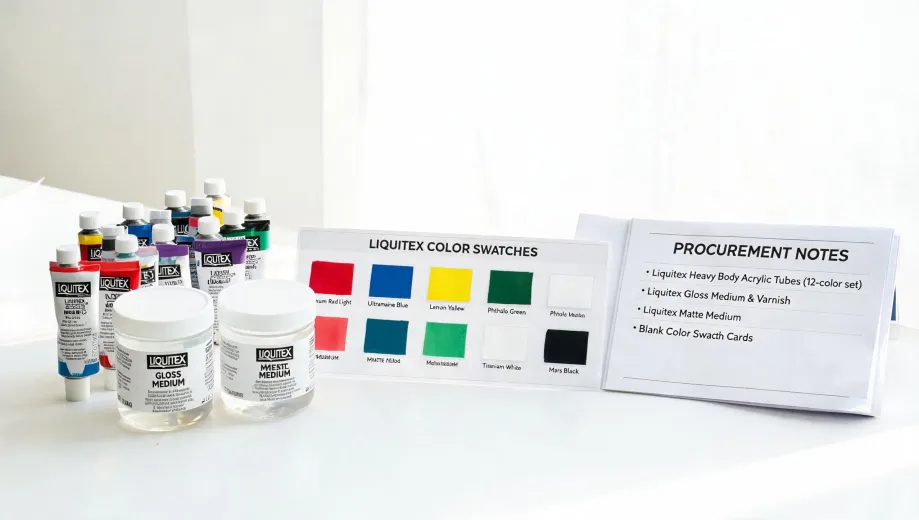
The second: an employee planning a team-building event asked whether we could purchase acrylic paints for an office art project, provided "it doesn't irritate skin." I told them to go to an art supply vendor—safety specs actually matter, and I'm not the expert on that. I later learned (because the office art project happened anyway) that people ask a more complicated question than they realize: most water-based acrylic paints are safe for skin once dry, but wet paint can clog pores, and paints containing cadmium or cobalt require disposal warnings. That's why I shouldn't be tacking "acrylic paint" onto an office supply order—and why asking "is it safe" matters more than getting an "it's probably fine" from a supplier.
My point: good procurement isn't about buying everything. It's about knowing the boundaries of your category and knowing when to tell people to go elsewhere.
Boundary Conditions: When This Approach Doesn't Work
Our consolidation approach works poorly for companies under 20 people or for teams with highly variable demand (e.g., planning different events each month). In that case, "just buy what you need" can beat standardization, because storage costs more than the savings. Our method works because our needs are predictable enough that we can forecast monthly usage.
Also, if you consolidate vendors based on delivery reliability that turns out to be temporary (during a logistics bottleneck, for instance), you could lock into a vendor that no longer performs. We re-certify quarterly. But I think that concern is somewhat academic for the SKUs we cover.

Nabil Farouk
Nabil Farouk is a sustainable office and education procurement analyst covering recycled paper, refillable writing instruments, remanufactured cartridges, modular furniture, reusable filing products, classroom consumables, and packaging reduction. He applies ISO 14021, ISO 14040, and ISO 20400 principles while examining recycled-content evidence, chain of custody, product life, refill yield, repairability, material disclosure, packaging mass, transport density, take-back options, and lifecycle cost. His guides help enterprise buyers, school districts, distributors, and ESG teams compare environmental claims with functional performance, supply continuity, user acceptance, maintenance, and total purchasing value.