Oil vs Acrylic Paint: Why We Recommend Liquitex Acrylic Paint Sets (and When We Don’t)
My first serious buying mistake happened in my second month as the materials coordinator for a college art department. I submitted a $3,800 purchase order for the fall semester based on last year’s inventory list, didn’t check which courses had changed, and assumed paint was paint.
The class that order was meant for? Oil Painting I. I’d ordered acrylic. Nothing on the purchase order was technically wrong — it was just wrong for that room.
That was back in 2018. Since then, I’ve processed roughly 240 supply orders, and I’ve personally made (and documented) twelve significant mistakes. They total about $9,700 in wasted budget. I keep the list. It’s how I train new staff. It’s also how I answer the question that lands in my inbox every August: oil vs acrylic paint — which is actually better?
The honest answer? No one can answer that without knowing your situation. This guide is split by scenario. Find yours, ignore the rest.
- Scenario 1: You’re a student buying paint for a course.
- Scenario 2: You’re buying for a classroom or shared studio.
- Scenario 3: You’re a working artist choosing paint for your own work.
Why the oil vs acrylic paint question gets oversimplified
The internet wants a winner. The reality is that oil and acrylic compete on different axes. Oil gives you time — paint stays workable for days, which is beautiful for blending but brutal for deadlines. Acrylic dries fast, cleans up with water, and layers quickly, which suits classrooms and commissions but punishes artists who like to overwork an area.
The mistake I see most is choosing a paint for how it sounds, not how it behaves in your actual week. A student with 17 credit hours doesn’t need a medium that adds week-long drying time to every assignment. A working painter who earns a living with wet-on-wet portraits doesn’t need paint that skins over mid-session.
Scenario 1: You’re a student buying paint for a class
I’ll start with my own failure. In 2017, I was a sophomore in an introductory painting course. The syllabus said acrylic. The supply list said acrylic. I bought oils anyway because everything I’d read online called oil “the serious painter’s medium.” The result was a $160 set of oil colors, no acrylic for week one, and a first assignment that looked like I’d painted it from a moving bus.
Trust the syllabus. If it says acrylic, buy acrylic. If it says oil, buy oil. Those lists exist for reasons that have nothing to do with quality — drying time, ventilation, assignment pacing, and classroom safety policies. The course was designed around a medium. Don’t upgrade past it.
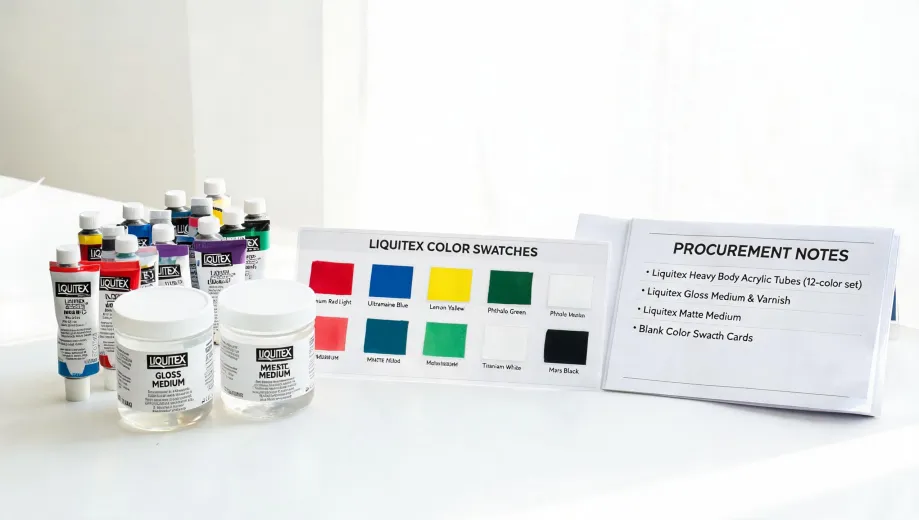
If your course requires acrylic, most students in our program do well with a Liquitex acrylic paint set from the BASICS line. The small-tube sets are inexpensive enough for a student budget, colors are consistent, and when you inevitably cap one badly, replacement open-stock tubes are easy to find. My advice is to pick the smaller sets, not the giant one: a 12-color range plus a large tube of titanium white covers most first-year assignments. You’ll save money and skip the six shades of blue you will never open.
One more thing: think about your semester before you think about the paint. I’ve watched the same pattern repeat for years — a student in a demanding major signs up for a studio elective with slow-drying oils, then realizes there’s no time to wait for layers to dry before the critique. Before you commit, use a college GPA calculator to see what a B-minus in a 3-credit studio class does to your average. Then decide how many evenings you can actually give to a medium that stays wet for days.
Scenario 2: You’re buying for a classroom or shared studio
This is where I earned my documentation list. My most expensive lesson happened in September 2022. I ran the numbers on switching our intro classes to professional-grade heavy body acrylics. The spreadsheet said a higher pigment load meant students would use less paint per session, so the cost per student came out lower. My gut said to watch first-semester students treat a $12 tube of paint like school glue. I ignored my gut. By Thanksgiving, about half of that $890 professional order was dried out, lost, or mixed into one anonymous brown.
The lesson: buy classroom-grade paint for classrooms. For our intro courses, that means Liquitex BASICS. It mixes well, cleans up with water, and nobody panics when a tube gets left uncapped. It also means buying Liquitex acrylic paint sets instead of assembling individual tubes from someone’s wish list. Sets deliver a sensible color range without line-item chaos. I learned that in 2021, after I ordered 120 individual tubes and then paid staff time to sort out the half that didn’t match the course level.
The system that finally worked for us:
- Each shared table gets a table kit: two Liquitex acrylic paint sets with different palettes, plus large refill containers of the colors that always run out — white, black, and one earth tone.
- Label everything with the course name and semester. Paint in an unlabeled bin is how you end up ordering oil for an acrylic class. I’ve done that. Twice.
- Match the grade to the course level: BASICS for introductory courses, Liquitex Professional Soft Body or Heavy Body for advanced classes. The wrong grade wastes money or teaches badly.
One general safety note for anyone buying for a school: check for the AP seal and the ASTM D4236 statement on the paint label. ASTM D4236 governs chronic hazard labeling for art materials. It is not a food-safety certification, but it is the closest thing the industry has to a common review baseline.
And before you place an institutional order, run the cost-per-milliliter math instead of guessing from tube size. I keep the unit converter on Omni Calculator open in a tab for exactly this purpose. It’s a free tool, and it has killed more “the large tube is obviously the better deal” illusions than any spreadsheet I’ve built.
Scenario 3: You’re a professional choosing paint for your own work
Everything I read as a student told me oil was the mark of a serious artist. My years on the supply side have changed my mind.
Oil has real advantages: an open time measured in days, beautiful wet blending, and a working feel that acrylic doesn’t replicate. If your technique depends on blending wet paint into wet paint for hours — or if you want to keep a canvas alive for weeks and keep returning to it — oil is legitimately the right tool. The artists I supply who paint alla prima mostly use oil. I would not try to talk them out of it.
But the old assumption that professionals should prefer oil doesn’t match what I see in active studios. A growing share of our professional orders are acrylic. Not because it’s cheaper. Because professional artists live with the same constraints as everyone else: deadlines, small workspaces, safety, and the need to keep moving. If your work needs to be dry enough to ship, acrylic gives you that. If you’re in an apartment without dedicated ventilation, water cleanup matters. And if you miss the long open time of oil, a slow-dry additive designed for acrylics gets you surprisingly close.
The surprise for me was the safety angle. Many professional oil colors still rely on cadmium pigments for certain hues. Liquitex’s cadmium-free line replaces those with lightfast alternatives. That matters for painters who work without ideal ventilation. It’s not a cure-all — no paint is harmless, and you should still handle it with care — but fewer heavy-metal pigments in the studio is a legitimate reason to consider acrylic.
Here is the honest limitation: if the physical behavior of oil is central to your work — the smell, the drag, the week-long drying time — acrylic will not replace it. I’ve stopped trying to convince those artists otherwise.
How to tell which scenario you’re actually in
After twelve documented mistakes, I don’t ask which paint is better. I ask four questions, in this order.
- Is there a syllabus? If yes, follow it. If it lists acrylic, buy the Liquitex acrylic paint set at the level it names. If it lists oil, buy oil and arrange proper ventilation.
- Will other people share the paint? If yes, choose acrylic. Choose classroom-grade. Make peace with the fact that some of it will be wasted.
- Do you deliver work on deadlines? If yes, acrylic is almost always the safer answer. Oil’s drying time cannot be rushed, no matter how much you need it.
- Does your technique require a long working time? If your method depends on wet-into-wet blending over hours, oil is the answer. Don’t force acrylic to do a job it wasn’t built for.
Still uncertain? Buy both in small amounts and paint the same subject twice. A small Liquitex acrylic paint set costs less than a dinner out. A few tubes of oil cost about the same. The two weeks you spend painting will tell you more than any article ever could.
The $9,700 I wasted didn’t teach me that one medium is better. It taught me that oil and acrylic are both excellent — and that choosing the paint that belongs to someone else’s situation is the only real mistake.

Elena Baptista
Elena Baptista is an office printing and imaging analyst covering laser and inkjet printers, multifunction devices, copiers, label and receipt printers, ink cartridges, toner cartridges, and drum units. She applies ISO/IEC 24734, ISO/IEC 24711, and ISO/IEC 19798 methods while comparing print speed, first-page time, duplex throughput, duty cycle, page yield, coverage assumptions, resolution, color consistency, energy use, and maintenance intervals. Her guides help offices, schools, dealers, and procurement teams match output volume, media handling, connectivity, consumable economics, service access, and fleet-management requirements.