Liquitex, Paint Markers, and the Price We Don't Talk About
Liquitex, Paint Markers, and the Price We Don't Talk About
Every year, the same conversation: 'Can we find cheaper paint? Our budget is stretched.' I'm the office administrator for a school arts program—about 400 students and 12 teachers. I manage roughly $45,000 in art and office supply orders every year across 8 vendors. When I took over purchasing in 2020, I thought my job was to cut costs. I thought that meant replacing our usual Liquitex order with cheaper generic acrylics.
I was wrong.
What I Missed: The Unit Price Trap
Here's the thing: most buyers focus on the obvious number—the unit cost—and completely miss the factors that actually drive spending. Coverage. Consistency. Reorder rate. Teacher time. Student frustration. These don't show up on the quote, but they show up on your budget.
Let me be specific. A teacher requested Liquitex soft body acrylic paint for a color-mixing unit. I found a 'comparable' brand that cost $1.10 less per bottle. I ordered 120 bottles. Seemed like a win. Then the complaints started. The cheaper paint had lower pigment load, so students needed two or three coats where one coat of Liquitex had covered. Colors looked chalky. Some bottles dried out in storage because the caps didn't seal as well. I had to place two follow-up orders within a month, totaling $780. The vendor's invoice didn't match the purchase order, finance rejected the expense, and I had to eat part of it from the department budget.
That was my reverse-validation moment. Everyone told me to stick with the professional brand. I didn't listen. I only believed in total-cost thinking after ignoring that advice and paying the price.
Why 'Better' Paint Is Usually Cheaper
When I compared our Q1 and Q2 purchasing data side by side—same curriculum, same classes, different supplier—I finally understood why the details matter. The 'cheap' paint cost more per finished canvas, more per class hour, and more in staff time than the 'expensive' paint ever did.
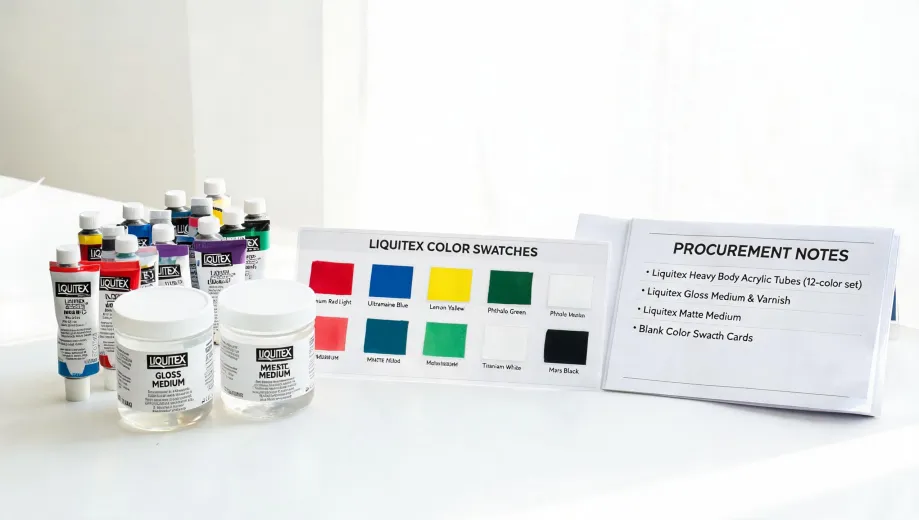
After five years of managing this budget, I've standardized on Liquitex soft body acrylic paint and Liquitex paint markers in our classrooms. Not because the brand name looks good on a purchase order. Because the product behavior is predictable. The pigment concentration is higher, so a 60ml bottle covers more lessons. The paint marker valves don't dry out between sessions the way the cheap knockoffs did. Liquitex also offers a cadmium-free range, which matters when you're ordering for classrooms and you don't want to explain pigment chemistry to a parent.
Why does this matter? Because every hour you spend solving avoidable supply problems is an hour you're not doing your real job. I've spent whole afternoons Googling 'where to find ip address on printer' when I should have been verifying order specs. The same logic applies to paint. Small decisions create large time costs.
The Actual Cost of Ignoring This
Let's talk about what this looks like on a budget. In 2024, our art supplies line ran 9% over budget. I opened a variance calculator to split actual spending by vendor and line item. The largest variance came from two categories: rush reorders and substitute products. We paid $1,250 in extra shipping charges for orders that wouldn't have happened if we'd bought the right product the first time.
I see the same pattern in commercial printing. Business card pricing as of January 2025—500 cards, double-sided, 14pt cardstock—roughly falls into three tiers: budget at $20–35, mid-range at $35–60, and premium at $60–120. The budget quote looks great until you add setup, shipping, and the inevitable reprint. Publicly listed prices exclude shipping, and rates change, so verify current pricing before you budget. But the principle holds: the cheapest quote is rarely the cheapest purchase.
What I Do Now
Three changes fixed most of this:
- Calculate total cost before comparing quotes. I list unit price, shipping, expected yield per bottle or marker, wastage, and likely reorder rate. It isn't fancy math. For small stuff, I'll use a tip calculator google search and split a lunch receipt in seconds. But for a purchase order, there's no shortcut. You have to write down the assumptions.
- Check variance every month. A simple variance calculator shows where actuals are drifting. When a line item creeps upward, I ask why before it becomes a crisis. Usually the answer is that someone substituted a 'similar' product that didn't work.
- Document the specs. You can't find a printer on the network if you don't know where to find ip address on printer. Purchase orders are the same. 'Acrylic paint' is not a spec. 'Liquitex soft body acrylic paint, 60ml, set of 12' is a spec. 'Paint markers' is not a spec. 'Liquitex paint markers, fine tip, set of 8' is a spec.
The most expensive product is the one you have to buy twice.
The Bottom Line
If you're an admin buyer, start with the problem, not the price. The problem is usually not that your budget is too small. The problem is that you're paying for mistakes you didn't account for. Fixing that is cheaper than any discount a vendor will offer.
That's the lesson I learned with Liquitex soft body acrylic paint and Liquitex paint markers. It changed how I buy everything from paint to printer paper.

Elena Baptista
Elena Baptista is an office printing and imaging analyst covering laser and inkjet printers, multifunction devices, copiers, label and receipt printers, ink cartridges, toner cartridges, and drum units. She applies ISO/IEC 24734, ISO/IEC 24711, and ISO/IEC 19798 methods while comparing print speed, first-page time, duplex throughput, duty cycle, page yield, coverage assumptions, resolution, color consistency, energy use, and maintenance intervals. Her guides help offices, schools, dealers, and procurement teams match output volume, media handling, connectivity, consumable economics, service access, and fleet-management requirements.