Is Acrylic Paint Waterproof? Liquitex Heavy Body vs. Basics for Real Projects
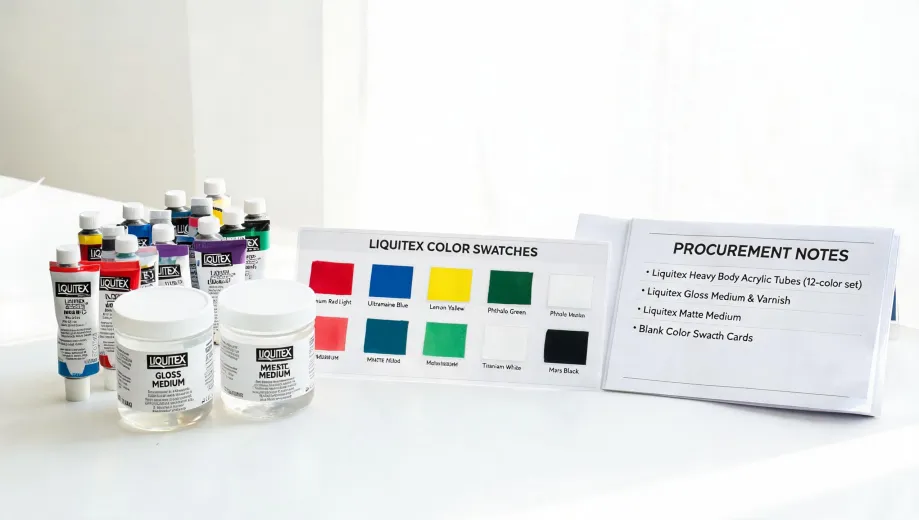
Some questions show up when you don't have time to lose. 'Is acrylic paint waterproof?' is one of them. I've gotten that call at 4:00 p.m. from a teacher who has a school art show the next morning, from a parent whose kid painted a Pokemon binder, and from a designer who just used copy paper for a color test and needs to know if it can be cleaned up. In my role coordinating rush supply orders for schools and studios, I've handled more than 200 of those time-sensitive paint questions—so here's the practical version.
The comparison framework
This isn't a 'which brand is better' rant. Liquitex makes both professional and student-level acrylics, and they both have a place. The comparison in this article is between Liquitex heavy body acrylic paints and Liquitex Basics, and I'm looking at them through three lenses:
- Water resistance: Once it dries, will it wash away or bead up?
- Surface fit: Does it work on copy paper, binders, canvas, or primed panels?
- Durability and budget: Can a small order get you through a real project?
Maybe that seems obvious. But the obvious stuff gets skipped when you're in emergency mode.
Water resistance: What 'waterproof' actually means
Let's answer the search question directly. Acrylic paint is water-based while wet, but once it cures, it forms a plastic-like film. That film is water-resistant—which is not the same as fully waterproof in every direction. Water droplets on the surface will bead up, and a damp cloth wipe won't ruin it. But a long soak, constant moisture, or heat can soften the film. If you need a project to survive rain or washing, varnish is the step people usually skip.
From the outside, it looks like the paint itself is waterproof because a dried paint spill cleans up easily. The reality is that the binder—the acrylic polymer holding the pigments together—does the heavy lifting. That's exactly where Liquitex heavy body acrylic paints show their strength. They have a higher pigment load and a thicker, more robust binder-to-pigment ratio. Once that film sets on a properly primed surface, it can handle more wear than a student-grade paint with a leaner formula.
But here's the part that surprises people: Liquitex Basics will also pass the water-beading test. It's an acrylic, not a watercolor. So if you're deciding between heavy body and Basics solely because you're terrified of water, you're probably overthinking it. The bigger differences are in texture, coverage, and how much moisture the surface can tolerate.
Surface fit: Copy paper, Pokemon binders, and other tricky surfaces
This is where 'is acrylic paint waterproof' becomes the wrong question. The right question is 'will the surface survive the water in the paint?'
Most acrylic paint contains water, and water warps paper. Copy paper is especially tricky. It's thin, not sized for wet media, and not designed for acrylics. If you put Liquitex heavy body acrylic paint on copy paper and let it dry, the paint film may be water-resistant—but the paper underneath will curl and can turn brittle. In March 2024, a teacher called me 36 hours before an art show. Her students had painted on copy paper, and the edges were curling like potato chips. The paint wasn't failing. The paper was. We mounted the sheets on foam core with acid-free tape, and it bought the show enough time.
What about a Pokemon binder? I had a parent call me once because their kid painted the front of a binder with Liquitex Basics. The result looked great for about two days, then started peeling at the edges. Why? That glossy PVC cover doesn't have tooth. Acrylic needs a little roughness or a primer to grip. If you're going to paint a binder cover, sand it lightly with fine grit, wipe off the dust, and use a thin coat of gesso or acrylic medium first. Then the paint will bond much better. The same logic applies to plastic, glossy cardboard, and even lacquered wood.
On canvas or primed wood, both Liquitex heavy body and Basics do what you'd expect. The primer gives the paint something to bite into, and because it's not absorbing all the water immediately, the film forms evenly. If you want the strongest adhesion on a non-cotton surface—binder, plastic, craft foam—using an acrylic medium as a base is the move. It's the difference between paint sitting on the surface and paint becoming part of it.
Heavy body vs Basics: What actually differs
Body and texture
Liquitex heavy body acrylic paints are thick. They hold brushstrokes and peaks, which is ideal for textured work or paintings where you want the paint to stay where you put it. Liquitex Freestyle brushes pair well with heavy body because the synthetic bristles are stiff enough to push that dense paint around without splaying. If you've ever tried to drag heavy body paint with a soft watercolor brush, you know why the tool matters.
Liquitex Basics is more fluid. It's still a full acrylic, but it levels out more and doesn't hold a peak. For base coats, large gradients, classroom projects, and anyone whose budget doesn't stretch to a full professional line, that's not a flaw. It's a feature. You can cover a sheet of copy paper or a small canvas with Basics in a fraction of the time.
Coverage and pigment load
Heavy body gives you more color power per brushful. A little goes a long way, and because the pigment load is high, you don't need six coats to get a flat red or black. Basics has less pigment by volume, so you might need another coat—especially with lighter colors. For a small order, that math matters. One tube of heavy body might outlast two tubes of Basics on a pigment-heavy project. But for a relaxed paint-along or a student learning color mixing, Basics is easier to control and clean up.
Durability check
Once dry, the heavy body film is generally tougher and more flexible in thick layers. Basics dries a little thinner, which can actually be helpful if you want to avoid cracking on flexible surfaces. If you're painting a Pokemon binder, a thin Basics layer will flex with the binder better than a thick heavy body slab. If you're making textured art that'll hang on a wall, heavy body's thickness is the point.
Small order? That's not a problem
Here's where I have to get on my soapbox. A lot of art supply procurement is set up to expect big orders—classroom packs, full palettes, custom kits. But I've sent out one tube of heavy body and one set of Freestyle brushes on a rush order, and I was glad to do it. Small orders are how artists test a product before committing. A school might start with ten tubes of Basics to see if the students can handle them. That's not a waste. That's how relationships start.
Don't let anyone make you feel like you have to buy more than you need. A small batch of Liquitex Basics plus one or two heavy body tubes in the colors you actually rely on is a very normal setup. It's probably what I'd pack if you had to paint a classroom mural by Friday. You'd use Basics for the broad areas, heavy body for details that need to stand up, and Freestyle brushes for the work in between.
Varnish: The final waterproofing layer
If you need the finished piece to actually be waterproof, stop choosing between paints and start choosing a varnish. A water-based acrylic varnish can be brushed or sprayed over the dry painting. It adds a clear protective layer that fights dirt, moisture, and UV fading.
There's a common belief that a more expensive tube of paint alone makes your project waterproof. The causation runs the other way: price buys pigment density and handling, not miracle rain protection. Once you put varnish on a fully cured painting, that's what creates the most water-resistant surface. And remember to let the painting cure before varnishing—at least 3 to 5 days if you can wait. In a rush? A 24-hour dry time is the minimum I'd trust, and I'd test one corner with a water drop first.
So which one should you choose?
If you're asking 'is acrylic paint waterproof' because you're comparing Liquitex heavy body acrylic paints to Basics, choose based on the job, not the label.
- Choose Liquitex heavy body acrylic paints for textured work, details, or any assignment where you want maximum pigment density and film strength.
- Choose Liquitex Basics for classrooms, preliminary studies, big areas, or budget-conscious projects where a slightly thinner film is fine.
- Pick Liquitex Freestyle brushes if you want synthetic brushes that can handle both heavy body and thinner acrylics without falling apart.
- Always use a primer on copy paper, binders, or glossy surfaces—you won't get a waterproof result if the support can't hold the paint.
One last note: if you're shipping finished work, remember that USPS has size and thickness rules for large envelopes. A heavy body acrylic painting on a thick binder cover might be too thick for a flat envelope and can get bent or returned. According to USPS, as of 2025, a large envelope can be up to 12 x 15 inches and 0.75 inches thick. Texture from heavy body paint can easily push past that. Use a box if you're not sure.
So, the short answer: acrylic paint is not waterproof in the 'submerge it and never care again' sense. But it is water-resistant when dry, and with the right surface prep plus varnish, it's about as tough as you can get. Whether you invest in Liquitex heavy body or stretch a budget with Basics, the real lesson is the same: don't skip the primer, and don't test it on copy paper an hour before the deadline.

Elena Baptista
Elena Baptista is an office printing and imaging analyst covering laser and inkjet printers, multifunction devices, copiers, label and receipt printers, ink cartridges, toner cartridges, and drum units. She applies ISO/IEC 24734, ISO/IEC 24711, and ISO/IEC 19798 methods while comparing print speed, first-page time, duplex throughput, duty cycle, page yield, coverage assumptions, resolution, color consistency, energy use, and maintenance intervals. Her guides help offices, schools, dealers, and procurement teams match output volume, media handling, connectivity, consumable economics, service access, and fleet-management requirements.