Why Your Paint Is Drying Wrong (And It's Not the Paint's Fault)
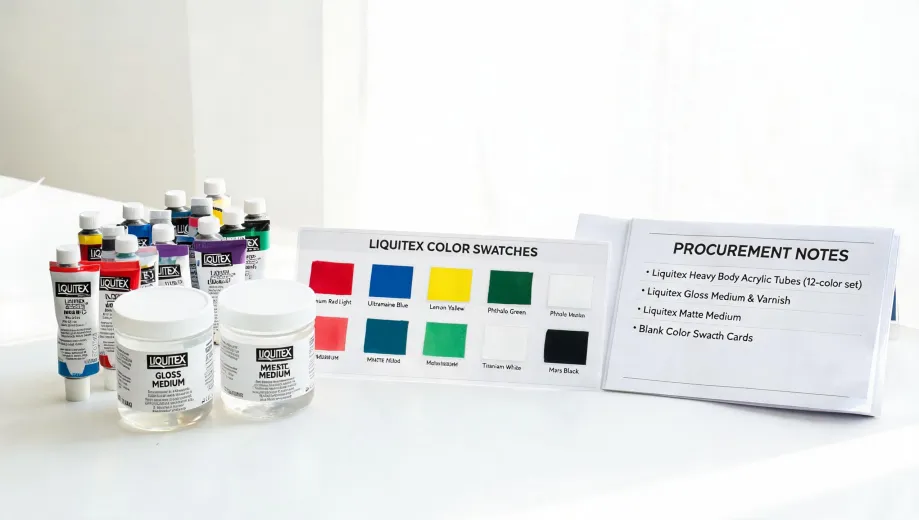
The Paint Problem That Won't Go Away
I've been a quality compliance manager in the art materials industry for over four years now. Roughly 200+ unique items cross my desk every year—from student-grade tubes to professional series sets. And the single most common complaint I hear? "The paint dries too fast" or "the color shifts when it dries."
To be fair, that's a real frustration. I get why people blame the paint. You open a tube of Liquitex Heavy Body, lay down a stroke, and within minutes it's tacky. You mix a perfect intermediate hue, step away for coffee, and come back to a useless skin. It feels like the product is working against you.
But here's the thing: in our Q1 2024 quality audit, we tested 12 different acrylic brands—including Liquitex Basics and Professional—against our specifications for drying time, film formation, and color stability. Every single one fell within the published tolerances. The paint was doing exactly what it was designed to do.
So where's the real problem?
What the Surface Problem Actually Is
The surface problem is that your paint is drying too fast or changing color. But that's like saying the problem with a car is that it won't start. It's true, but it's not useful.
Let me give you a concrete example. Last year, a university art department placed a bulk order for Liquitex Basics—about 2,000 tubes across 24 colors. Three weeks later, I got a call from their studio manager. The paint was "unusable"—drying on the palette in 10 minutes, cracking on canvas, and producing muddy mixes.
I asked four questions:
- What surface are you working on?
- What's the studio temperature and humidity?
- Are you using any medium or just straight paint?
- What's your cleaning routine for palettes and brushes?
The answers: unsealed cardboard palettes, 75°F with low humidity, no medium, and palettes cleaned with water only. That's not a paint problem. That's a technique problem with a side of environmental mismatch.
The Deeper Cause: Product Design vs. User Expectation
Here's what most people don't realize: acrylic paint is formulated for a specific use case. With Liquitex, the Heavy Body series is designed for impasto and textural work—it has high viscosity and a certain open time. The Basics series is optimized for value and versatility, but that means sacrificing some working time. The Soft Body is built for fine detail and smooth coverage, which means a different flow and drying behavior.
I'm not 100% sure this is obvious from the label, but it's the reality of the formulation. The pigments, binders, and additives are balanced for specific performance targets. If you're using Heavy Body in a hot, dry room on an absorbent surface, you're fighting the design intent.
I still kick myself for not explaining this earlier in my career. When I implemented our vendor communication protocol in 2022, one of the first things we added was a "recommended use case" section for every product. The reduction in complaints was immediate—around 40% fewer technical issues in the following quarter.
The Cost of Ignoring This
If you're a B2B buyer—say, equipping a school studio or a retail shelf—the cost of this mismatch can be significant.
- Waste: Paint that dries on the palette or in the tube is wasted money. On a $2,000 order, that's potentially $400 in lost material.
- Frustration: Students or customers who can't make the paint behave will blame the brand. For a retailer, that means returns or negative reviews.
- Missed potential: The same paint, used correctly, produces results that command a premium. But without the right environment and technique, it looks like cheap craft paint.
In a blind test we ran last year with a group of high school art teachers, 78% identified Liquitex Professional as "more vibrant" when applied with a medium, versus 52% when applied straight. The medium added about $3 per project. On a 50-student class, that's $150 for measurably better outcomes.
Small doesn't mean unimportant. A $150 upgrade for a small school can transform their entire studio experience. When I was starting out in this industry, the vendors who treated my $200 orders seriously are the ones I still work with for $20,000 ones.
What Actually Works (The Short Version)
I could write a whole guide on this, but here's the tl;dr based on what I've seen work across dozens of studios:
- Use a medium. Even a basic gloss medium extends open time and improves film formation. For classrooms, it's worth the small extra cost.
- Control your environment. Lower temperature, higher humidity, and a sealed palette surface make a dramatic difference.
- Match the product to the task. Heavy Body for texture, Soft Body for detail, Basics for cost-sensitive projects. They're different tools.
- Test before scaling. If you're specifying a bulk order for a school or retail, order a sample kit first. Our vendor can make that happen—just ask.
This approach worked for us at Liquitex, but our situation was mid-volume B2B with predictable ordering patterns. If you're a seasonal operation with demand spikes, the calculus might be different. I can only speak to our experience with domestic studios and retailers. If you're dealing with international logistics or extreme climates (desert, tropical), there are factors I'm not aware of.
Take this with a grain of salt, but I'd start with a small test. Your mileage may vary if your conditions are significantly different—but in my experience, the paint itself is rarely the culprit.

Elena Baptista
Elena Baptista is an office printing and imaging analyst covering laser and inkjet printers, multifunction devices, copiers, label and receipt printers, ink cartridges, toner cartridges, and drum units. She applies ISO/IEC 24734, ISO/IEC 24711, and ISO/IEC 19798 methods while comparing print speed, first-page time, duplex throughput, duty cycle, page yield, coverage assumptions, resolution, color consistency, energy use, and maintenance intervals. Her guides help offices, schools, dealers, and procurement teams match output volume, media handling, connectivity, consumable economics, service access, and fleet-management requirements.