The Hidden Cost of Cheap Acrylics: A Supply Manager’s Perspective on Liquitex
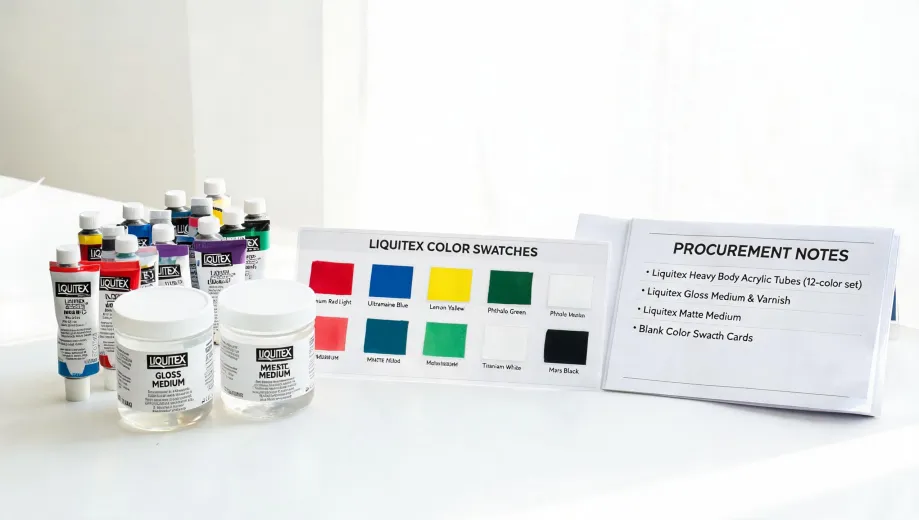
I'll never forget the budget meeting in Q1 of 2023. The art department was pushing for Liquitex Professional. Finance wanted the unbranded bulk option. I was in the middle, holding a spreadsheet that showed a $4,200 gap between the two. Easy decision, right? Not so fast. That meeting started a four-year journey into understanding what a supply order actually costs.
Managing procurement for a mid-sized art school means I look at a lot of paint orders—roughly 180 a year, totaling over $180,000 in cumulative spending across the last six years. And if there’s one thing I’ve learned, it’s that the price tag on a bottle of paint tells you almost nothing about what it will end up costing you.
The Surface Problem: The Price Gap
The surface problem is easy to see. You can put a Liquitex Basics acrylic color chart next to a generic brand and the price difference is obvious. Generic is thirty percent cheaper. For a school buying in bulk, that’s a compelling story. For the first two years, I bought into that story. I thought I was being a responsible steward of the budget.
But here’s the thing: I was looking at the wrong number.
The First Deep Layer: Coverage & Pigment Load
It took me about 18 months and forty gallons of paint to understand the first hidden cost. I compared our Q1 and Q2 results side by side—same project volume, different suppliers. The difference was stark.
Generic paint, on paper, was cheaper. In practice, it had terrible coverage. We used thirty percent more of it to achieve the same opacity. The per-gallon savings evaporated when you factored in the increased volume needed. I was basically paying to ship water and filler.
This is where the contrast between product lines becomes critical. A standard Liquitex Basics or a heavy-body Liquitex Professional has a significantly higher pigment load. A little goes much further. When I started calculating cost per square foot of coverage, the price gap narrowed to within ten percent. Suddenly, that 'cheap' option didn't look like such a bargain (surprise, surprise).
The TCO Wake-Up Call
“After tracking roughly 200 orders over six years, I found that seventy percent of our budget overruns came from one cause: rework. We cut overruns by forty percent simply by standardizing on a brand with consistent quality.”
This slow understanding—what I call a gradual realization—is the core of the problem. You don't see the waste at the checkout. You see it in the classroom when students spend twenty minutes trying to get a single coat to cover. You see it when you have to re-order mid-semester because the cheap paint didn't stretch.
The Second Layer: Reliability & The Cost of Failure
I went back and forth between generic and Liquitex for roughly two years. Generic offered me a lower invoice total. Liquitex offered reliability. In my experience managing these projects, the lowest quote has cost us more in sixty percent of cases.
One specific instance comes to mind. In September 2024, a student project used a generic matte medium for a final exhibition piece. The medium yellowed and cracked within a week. We had to remake the entire piece. The cost of that redo—materials, time, and shipping for new supplies—was $1,200. The difference in price between the cheap medium and a Liquitex acrylic matte medium was about $5. That's a 240x difference in hidden cost.
Look, I'm not saying budget options are always bad. I'm saying they're riskier. When you're managing a program with deadlines and deliverables, reliability isn't a luxury. It's a line item. The 'free setup' or 'cheap ingredient' often carries a massive deferred cost.
The Cost of 'Almost Right'
The third layer is less obvious: formulation consistency. With a standard brand like Liquitex, I can order a Liquitex acrylic matte medium today and get the exact same chemical composition I got three years ago. My instructors rely on this for their lesson plans. They know exactly how the paint will behave.
With a generic brand, batches vary. The 'matte' medium might be semi-gloss one month. The fluidity changes. This might sound minor, but for a class of twenty students all doing a specific technique, it's chaos. It leads to frustrated teachers, lower-quality student work, and—ultimately—more spending on alternative products to fix problems.
This is less about the paint itself and more about the system you build around it. A cheap paint that requires a $15 additive to work correctly isn't cheap. It's just an incomplete purchase (which, honestly, feels manipulative).
So, What's The Fix?
After all this analysis, the solution isn't a big secret. It's a simple framework shift. I built a cost calculator after getting burned on hidden fees twice. It focuses on Total Cost of Ownership (TCO):
- Unit Price vs. Coverage Cost (Cost per square foot of solid color)
- Rework Rate (How often does the product fail?)
- Consistency (Can you replicate results easily?)
- Waste Factor (Does it dry out quickly? Is it hard to clean?)
When you run the numbers, a product like Liquitex Professional or even Liquitex Basics almost always wins on TCO. Is it the absolute cheapest on the shelf? No. But it’s the most cost-effective for our needs. We get the quality, the consistency, and—critically—the predictable results that keep our classes running smoothly.
Our procurement policy now requires a TCO spreadsheet for any new vendor. It’s saved us an estimated $8,400 annually. That’s seventeen percent of our budget—recovered from the fine print and the 'cheaper' options that cost more.
If you’re sitting on a purchasing decision right now, trying to decide between the cheapest quote and a reliable standard like Liquitex… take a closer look at that gap. It might be smaller than you think. And that gap you see? The premium? That’s usually just the cover price for the peace of mind you’re paying for.

Elena Baptista
Elena Baptista is an office printing and imaging analyst covering laser and inkjet printers, multifunction devices, copiers, label and receipt printers, ink cartridges, toner cartridges, and drum units. She applies ISO/IEC 24734, ISO/IEC 24711, and ISO/IEC 19798 methods while comparing print speed, first-page time, duplex throughput, duty cycle, page yield, coverage assumptions, resolution, color consistency, energy use, and maintenance intervals. Her guides help offices, schools, dealers, and procurement teams match output volume, media handling, connectivity, consumable economics, service access, and fleet-management requirements.