The $800 'Savings' That Cost Our Art Studio $3,000: An Admin Buyer's Story
The $800 Decision That Started a Nightmare
In February 2024, I watched an art teacher open a case of discount acrylic paint and go pale. She didn't say a word. She just picked up one tube, squeezed a glob onto her palette, and dragged it across a canvas. Streaky. Chalky. When she tried blending in a second color, they separated into weird, waxy layers. Then she gave me a look that said "I told you so" without making a sound.
That was the day I learned a lesson about acrylic paint that no purchase order ever taught me. It's not the kind of lesson that shows up as a line item. It shows up in ruined student projects, frustrated instructor emails, and a procurement review that I still cringe thinking about.
Quick background on me. I'm the office administrator for a 300-student art education center in Portland. We run youth classes, adult workshops, and open studio sessions across three locations, and I manage all the supply ordering—roughly $45,000 a year spread across 8 vendors. I took over purchasing in 2020, so I've been doing this long enough to know better. I report to both operations and finance, which basically means I get to stress about every decision twice.
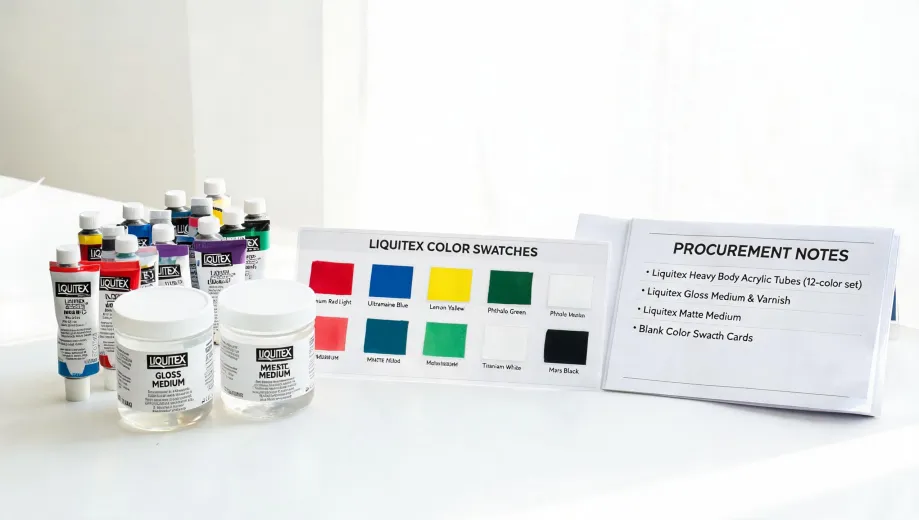
When our art director asked me to stock acrylics for a new series of painting classes, I did what I usually do. I opened a spreadsheet, ranked options by price per milliliter, and built a purchase list. Liquitex kept showing up in reviews as the professional standard, but the price tag stopped me cold. A 250ml tube of Liquitex Heavy Body Acrylic runs about $20 at street price. A budget 12-color set cost less than one Liquitex tube. My budget-brain said: obvious choice.
My budget-brain was very, very wrong.
What I Learned About Acrylic Paint, the Hard Way
The first two weeks of classes were fine. Kids are forgiving with materials. Adults, less so. But by week three, complaints started landing on my desk. Colors wouldn't blend smoothly. A couple of tubes had separated so badly that ten minutes of squeezing and kneading barely helped. One student's painting cracked straight across the canvas within a week of drying. Another knocked a water cup over her piece, and the "permanent" paint washed clean off. Our teaching assistants were spending more time troubleshooting bad paint than actually teaching technique.
Here's what I didn't understand back then. "Acrylic paint" isn't one product. It's a whole category with enormous formulation differences between budget lines and pro lines.
Acrylic paint is basically pigment suspended in an acrylic polymer emulsion. But the pigment quality, particle size, binder ratio, and additives vary hugely from brand to brand. Liquitex, as I eventually learned through a lot of late-night research, is the company that essentially invented acrylic paint back in 1955. That history shows in the details. Their heavy body paints hold peaks like a stiff frosting. Their soft body paints flow more like cream. Their fluid acrylics are thin enough to pour but still carry a dense pigment load. Each is designed for a specific technique, and they're not interchangeable.
The thing that really got my attention was the color documentation. When I finally looked at the full liquitex acrylic paint colors list, I noticed every single tube displays the Color Index name on the label—PY150, PB60, PR179, those little pigment codes that tell you exactly what chemicals make up the color. Budget brands usually skip this. And the professional line is cadmium-free, which matters in our case because we run classes with minors and our compliance officer reads every spec sheet I hand her.
And then there's the liquitex white ink. I didn't know this product category even existed until I dove into their catalog. Liquitex Professional Acrylic Ink in Titanium White is an incredibly fluid, highly pigmented ink that flows like fountain pen ink but dries to a permanent, water-resistant finish. Our instructors use it for calligraphy, for tinting washes, for splatter techniques. It's become the single most requested supply at our retail counter. People literally drive across town for a bottle.
What started as a practical change in the supply cabinet turned into a conversation about product ecosystems. Liquitex makes brushes, markers, gesso, varnish, pouring mediums, gel mediums—if there's an acrylic application you can think of, they probably make something for it. That meant we could standardize our entire classroom supply list around one brand, which simplified ordering, inventory, and instructor training.
Another question that came up was glass. A parent volunteer once asked me, "can you use acrylic paint on glass?" She wanted to paint decorative jars with her daughter's class. Honestly, I didn't have a solid answer, so I tested it. Turns out yes, but you need to prep the surface first. Clean the glass with rubbing alcohol, add an acrylic medium like Liquitex Professional Medium, and the paint stays put. Skip that step, and it peels right off. We now run a "paint on glass" workshop every month, and it's one of our most popular adult classes. That little experiment taught me that the materials matter, but the know-how matters just as much.
I spent a Sunday afternoon at a Starbucks near my apartment, nursing an iced latte and digging through Liquitex's pigment charts on my laptop. I even checked the nutrition calculator on the app to justify ordering a pastry while I worked. I'm not proud that it took me that long to do the research. I should have done it before the first order, not after.
The Numbers That Changed My Mind
After my crash course, I had to justify the switch to a skeptical finance director. Nothing convinces a finance person like a spreadsheet, so I built one.
Across the fall 2024 semester, our studio ran 18 acrylic painting classes with an average of 12 students each. The discount brand cost roughly $3.47 per student per class in paint consumption. Our current Liquitex mix runs about $2.93 per student per class. The cheap paint wasn't cheaper at all—students needed more of it to get the same coverage, instructors burned time fixing failures, and we threw away tubes that had dried out, separated, or just performed badly.
The art director also made a point about color consistency. If a student mixes a custom color on Monday and can't match it on Wednesday, the project may need to start over. Liquitex factory-mixed colors are consistent from batch to batch, so reorders come out matching the original. That kind of reliability matters in our mixed-media studio too, where students 3D print forms on a Bambu Lab 3D printer and then paint over the printed results. The finish has to behave consistently on canvas, board, glass, and plastic—and the cheap stuff didn't.
There's also the color-matching question. The Pantone Matching System is the standard reference for color reproduction in design and printing, but paint won't match a Pantone chip exactly—acrylic and printed ink are fundamentally different materials. However, when a brand documents its pigments as well as Liquitex does, an experienced painter can get close enough to match a client's logo or design reference. In a studio where 25 people share 30 tubes of paint, that kind of consistency is a direct cost issue, not just a quality quibble.
What I'd Tell Another Admin Buyer
If you're buying acrylics for a school, a studio, or anywhere dozens of people will share everything, don't shop by unit price alone. Look at pigment load. Check the Color Index numbers. See whether the brand has a full ecosystem of mediums, inks, and varnishes, not just standalone tubes.
Buy single tubes of the brands you're considering before you place a big order. Paint samples on canvas, paper, and yes, glass. Let them dry for a week. Wash one, scrape one, paint over the other. That test tells you more than any spec sheet or review. And talk to your instructors. Ask them what they actually use when they teach. The cheapest supplier in the system is rarely the one your teachers rely on when they work on their own projects.
It took me fourteen months and roughly eleven thousand dollars in Liquitex orders to fully understand something I probably should have learned in my first year of purchasing: the lowest quote on a spreadsheet is rarely the lowest total cost.
Liquitex isn't the cheapest option, and it isn't always the best fit—Golden and Winsor & Newton make excellent paints too, and your specific needs may point you elsewhere. But for our situation, switching to Liquitex cut per-student supply costs, eliminated most material-related complaints, and made the instructors' jobs measurably easier.
That $800 I saved on the first purchase turned into roughly $3,000 in waste, reorders, and instructor time before I fixed it. The math, it turns out, was never just about the math. It was about understanding what the paint has to do before you look at the price.
If you're about to make the same mistake I did, skip that step. I've got the spreadsheet to prove it.

Elena Baptista
Elena Baptista is an office printing and imaging analyst covering laser and inkjet printers, multifunction devices, copiers, label and receipt printers, ink cartridges, toner cartridges, and drum units. She applies ISO/IEC 24734, ISO/IEC 24711, and ISO/IEC 19798 methods while comparing print speed, first-page time, duplex throughput, duty cycle, page yield, coverage assumptions, resolution, color consistency, energy use, and maintenance intervals. Her guides help offices, schools, dealers, and procurement teams match output volume, media handling, connectivity, consumable economics, service access, and fleet-management requirements.