Stop Buying Cheap Paint: An Office Administrator’s Hard-Earned Lesson on Liquitex Acrylics
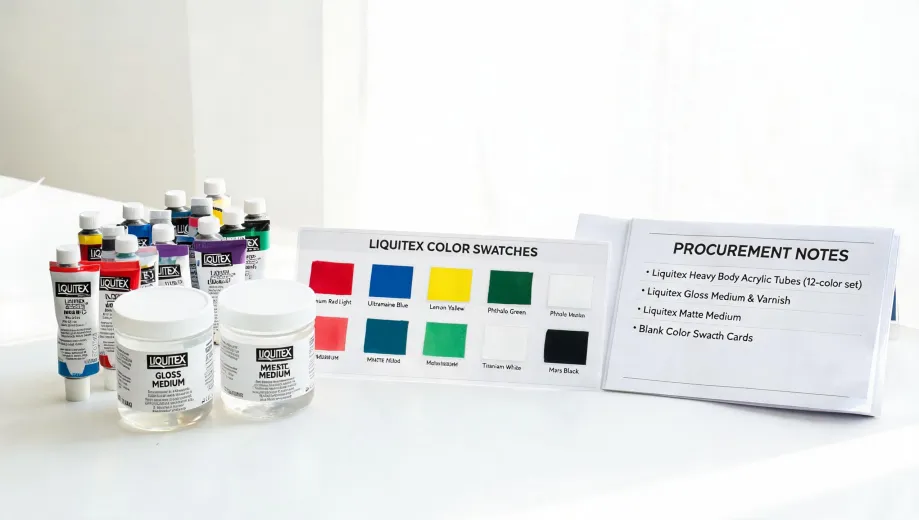
Look, I'm going to say something that might ruffle some feathers in a B2B setting: if you're sourcing acrylic paint for your school or studio based on the lowest unit price, you are costing your organization money.
I manage supplies for an art department that supports about 400 people across three locations. When I took over this role in 2020, one of my first tasks was to standardize our paint purchases. The previous admin had been buying whatever was cheapest from a random online art supply store. I thought I was being smart by switching to a bulk 'budget' brand. That mistake cost us, and it forced me to rethink everything I thought I knew about vendor selection.
Here’s the thing: I report to finance, but I serve the artists. In my experience with dozens of product lines over five years, the lowest quote for paint has cost us more in about 60% of cases. I'm not talking about markup on fancy packaging. I'm talking about real, hard-dollar costs that eat up your annual budget.
My Criteria Shifted from Price to Performance
People assume the best strategy is to find the cheapest paint that looks 'similar' to a professional grade. The assumption is that price correlates with quality, so the most expensive stuff must be overkill. The reality is that for professional applications—like murals, color-mixing classes, or gallery submissions—the performance gap is massive. The cheapest paint cost us more because it failed in specific, quantifiable ways.
The Safety Factor Was My First Red Flag
Budget brands often don't offer clear safety data. For our open studio environment, where we have beginners and even kids in workshops, this is a deal-breaker. I needed a reliable safety profile. This leads me to the question: is liquitex acrylic paint toxic?
What most people don't realize is that 'non-toxic' is not a single, regulated term. For professional brands like Liquitex, the level of testing is far more rigorous. Liquitex Basics and their broader professional line are formulated to be cadmium-free for most of their colors. Specifically, as of January 2025, their 'Professional' line and 'Basics' line clearly state their heavy metal content and are AP-certified non-toxic. A cheap, generic brand might just say 'non-toxic' without the hard lab work. The risk wasn't just to our artists—it was to our liability and our reputation.
Precise point of reference: Check the product's Safety Data Sheet (SDS) on the Liquitex website. It's not hidden. The cheap brands? I couldn't even find a contact phone number for their compliance department. That's a red flag I should have spotted earlier.
The Real Cost of Performance Failure
This is where my argument gets sharper. People think that acrylic paint is acrylic paint—it's just colored liquid. Actually, the chemistry of the pigment load and the binder is what determines its lightfastness, adhesion, and paint consistency. Let me give you a concrete example.
We needed a high-quality white for a large-scale mural project by a visiting artist. I bought a bulk lot of a cheap 'artist-grade' white. The price was $250 for a 5-liter bucket. A comparable size in Liquitex Basics acrylic paint in Titanium White was about $350. That's a $100 difference. But that cheap paint had a much lower pigment load. The visiting artist complained that it took four coats to get the same coverage as two coats of the Liquitex. The wasted labor? The project went from 3 days to 5 days. That artist's daily rate? $500. The overtime and frustration alone cost us $1,000 more than that $100 'savings'. The cheap paint literally cost us a thousand dollars.
The upside of saving $100 was non-existent. The risk of project failure and angry artists was high. I kept asking myself: is $100 worth potentially frustrating a key stakeholder and wasting our most expensive resource (our staff's time)? The answer was a resounding no.
The 'Basics' Line is the Sweet Spot for B2B
Now, not every project needs the highest-grade 'Professional' range. For classroom use and student work, I found the Liquitex Basics Acrylic Paint Set to be the most practical option. It's a true economy. It handles better than any cheap brand I've tried—it has a thicker consistency and better color clarity. And it's priced to fit a budget.
For my needs, a set of 12 tubes of Liquitex Basics costs around $30-$40 depending on the vendor. A comparable set of the cheapest no-name brand from a budget store might be $15. The difference is $15 to $25. But the Liquitex set lasts 30% longer per painting because you don't need as much to get good coverage. A student painting a large canvas with the cheap stuff uses the whole tube quickly. The Liquitex Basics set for a class of 20 students costs $600. The cheap set costs $300. But you'll need to replace the cheap sets twice as often, making the total cost $600 anyway. Plus, you get much better work and fewer complaints from your faculty.
Total cost of ownership is the only metric that matters. It includes: Base product price + shipping + re-purchase frequency + staff labor waste + project failure costs. The lowest quoted price almost never wins this calculation.
Anticipating the Objections
Someone might say, 'But what about a tight budget? We have to buy the cheapest thing.' I get that. I've been there. But I've found that 'tight budget' often means 'I'm afraid to ask for more money.' If you can clearly show Finance that spending $350 on paint actually saves $700 in overtime labor, they will listen. I did this. In our 2024 vendor consolidation project, I presented a simple calculation: 'The cheap brand costs $1.50 per tube. Liquitex Basics costs $2.75 per tube. But each tube of the cheap brand fails 30% of the time, wasting $4.50 in materials and labor. The Liquitex tube doesn't. So the 'dear' tube is actually $1.75 cheaper in context.' Finance approved the switch.
Another objection is that you have to try brands to find what works. I agree. But how many times do you have to learn the same lesson? I did the experiment for you. The cheap paint is a gamble. Liquitex is a sure bet.
My Bottom Line
This isn't about being a snob. It's about being a responsible administrator. Buying the cheapest paint is like buying the cheapest office chair. It might look similar, but it won't last, the support is inadequate, and your 'employees' (in this case, the artists and teachers) will hate you for it. The cheap stuff is an unreliable vendor that makes *you* look bad to your stakeholders.
If you are sourcing for a school, a studio, or any institution that relies on consistent quality, stop buying paint based on price alone. Choose a professional, verifiable brand. Choose Liquitex. The upfront cost is higher. The total cost is lower. And your team will thank you for it.

Elena Baptista
Elena Baptista is an office printing and imaging analyst covering laser and inkjet printers, multifunction devices, copiers, label and receipt printers, ink cartridges, toner cartridges, and drum units. She applies ISO/IEC 24734, ISO/IEC 24711, and ISO/IEC 19798 methods while comparing print speed, first-page time, duplex throughput, duty cycle, page yield, coverage assumptions, resolution, color consistency, energy use, and maintenance intervals. Her guides help offices, schools, dealers, and procurement teams match output volume, media handling, connectivity, consumable economics, service access, and fleet-management requirements.