Liquitex Brushes & Acrylic Paint: 4 Buying Mistakes That Cost Me $2,300 (And How to Skip Them)
-
Start Here If You Only Read One Section
-
Why Believe Me? Because I Paid for These Lessons
-
Mistake #1: Choosing the Wrong Acrylic Body
-
Mistake #2: Buying Cheap Brushes Before Trying Real Liquitex Brushes
-
Mistake #3: Skipping Gesso and Mediums
-
The Permanent Marker Incident (and How to Erase It)
-
That Week I Walked 14 Miles for One Bottle of Medium
-
Mistake #4: Ignoring the Humble 3-Ring Binder
-
A Note for Small Buyers: You're Not the Problem
-
When to Ignore All of This
Start Here If You Only Read One Section
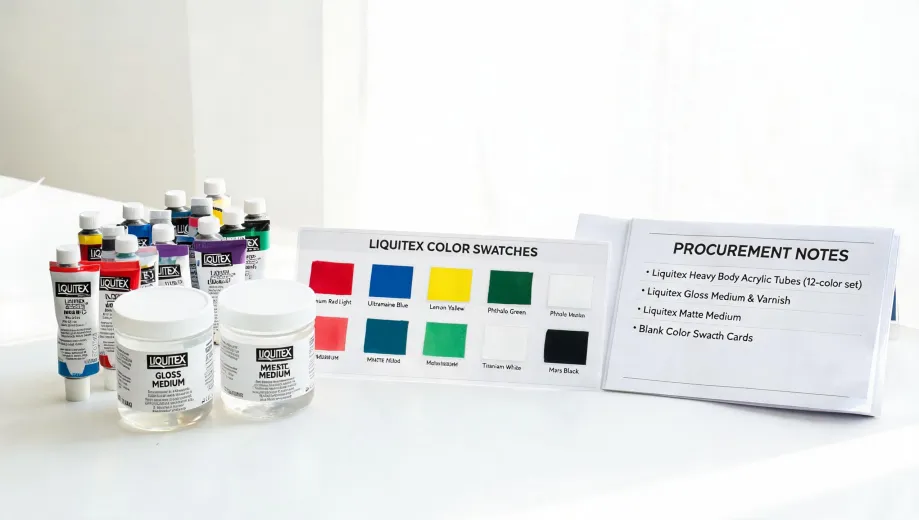
If you're wondering which Liquitex products to start with, here's my answer: buy one or two genuine Liquitex brushes (try the Freestyle or Freedom synthetic lines), one small set of acrylic Liquitex Basics, and one bottle of medium or gesso. That's it. Don't over-buy, don't "invest" in a massive set on day one, and don't skip surface prep. I've personally wasted roughly $2,300 on avoidable art supply mistakes since 2017, and almost every one came from rushing, assuming, or ignoring product line differences.
I handle supply orders for a small art education program, and I've made—and documented—14 significant purchasing mistakes. Some cost us money, some cost us a semester timeline, and a few were just embarrassing. This guide is the checklist I wish I had before placing that first order.
Why Believe Me? Because I Paid for These Lessons
In my first year (2017), I placed a $320 order for what I thought was "Liquitex paint for the classroom." It was heavy body. The teacher needed fluid acrylics for pouring and mixing. The boxes arrived, the teacher opened one tube, and said, "This is too thick for what we do." I literally had no response. I didn't even know the difference between heavy body and fluid at the time.
Everyone had told me to read the product specs before ordering. I didn't listen. $320 paint, $48 return shipping, and a two-week schedule delay later, I understood the lesson. If you're still reading, you get to learn it for free, which is more than I can say for my decision-making.
Mistake #1: Choosing the Wrong Acrylic Body
Liquitex makes acrylic paint in different consistencies: Heavy Body (buttery, holds brushstrokes and palette knife texture), Soft Body (smooth and creamy, good for blending), Fluid (thin, pours well, good for detail work), and Acrylic Ink (even thinner, for staining and technical pens). "Acrylic paint" is not enough information.
If you're painting on canvas with brushes, Heavy Body is likely your best bet. If you're doing pouring, dripping, or airbrush work, you want Fluid. If you're a beginner, start with Liquitex Basics, the student line. It's not just cheaper—it behaves predictably, and at about $3–7 per 22ml tube (based on Blick and Jerry's Artarama quotes, January 2025; verify current pricing), you can experiment without crying when you squeeze out too much.
I went back and forth between recommending Heavy Body and Soft Body for new painters for weeks. On paper, Heavy Body seemed right because it's what most tutorials use. But Soft Body is honestly easier to mix and less intimidating if you're learning color theory on a budget. I'd say: if you want texture, choose Heavy Body. If you want smooth flows and easy blending, choose Soft Body. And if you're not sure, choose Basics and find out by doing.
One more classroom consideration: Liquitex's professional line offers cadmium-free versions of many common colors. That's not the same as "edible" or "safe to apply like lotion," but fewer heavy metals in a shared studio is a meaningful advantage, especially when some students still taste paintbrushes even after you've told them not to.
Mistake #2: Buying Cheap Brushes Before Trying Real Liquitex Brushes
I used to buy giant brush sets in plastic tubes from big-box stores. Twelve brushes for $15? Seemed like a no-brainer. Then I watched our instructors struggle with bent bristles, shedding, and split tips after two or three washes. A frustrated teacher handed me a brush and said, "Feel this. Now imagine trying to teach edge control with it."
When I finally ordered genuine Liquitex brushes—the Freestyle line, which is synthetic and designed for acrylics—the difference was honestly embarrassing. Better spring, cleaner edges, no shedding. The Freedom line is a slightly more affordable step down but still miles ahead of the generic sets we'd been tossing away.
I don't have hard data on brush lifespan relative to price, and I wish I'd tracked it from the start. What I can say anecdotally is that our cheap sets lasted about four to six weeks under classroom use, and the Freestyle brushes were still going strong after ten months. If the cheap brush costs $1.25 and the Freestyle costs $12, the math works out over two semesters.
If you're building a kit, you don't need a twelve-piece set. Start with one flat brush and one round brush—I like sizes 6 and 8 or whatever feels comfortable in your hand. Use them until you understand why you want a filbert, a fan, or a liner brush. Then buy those.
Mistake #3: Skipping Gesso and Mediums
Here's where my "save money" instinct worked against me. I painted directly on cardboard, newsprint, even a bare door once, because I thought gesso was an upsell. The result: paint soaked in, colors dulled, and the surface warped.
Liquitex gesso exists for a reason. It seals the surface, gives the paint something to grip, and makes colors look the way they do in tutorials. A quart of Liquitex professional gesso costs around $20–$30 (check current prices), and it lasts a long time if you close the lid properly. That's a much better investment than an extra set of brushes you don't need yet.
Liquitex also makes a line of acrylic mediums—slow-dry, matte, gloss, gel, pouring, you name it. I ignored these for years because I thought they were specialist tools. Honestly, a bottle of slow-dry medium might be the easiest upgrade to your painting quality. It gives you more working time so your paint doesn't dry on the palette before you've even started.
The Permanent Marker Incident (and How to Erase It)
One afternoon in 2022, a student labeled every brush and palette in the classroom with permanent marker. Several of the new Liquitex brushes got marked. That was the week I learned how to erase permanent marker the practical way: color over it with a dry-erase marker, let it sit for a few seconds, then wipe. The solvent in the dry-erase ink breaks down the permanent marker's binder, and on non-porous plastic and metal, it works nearly every time.
If you're dealing with a finished acrylic painting, don't try this method on the painted surface—the dry-erase ink can soften the paint. Test in a corner if it's your own work, or just let the mark be a story. On raw canvas, you can paint over the area after a coat of gesso. Gesso really is the duct tape of this whole hobby.
That Week I Walked 14 Miles for One Bottle of Medium
In 2023, I needed a bottle of Liquitex slow-dry medium two days before a workshop. I figured I'd grab it locally and save the shipping time. Mistake: I didn't call ahead or check real-time inventory, and I ended up visiting four stores that said they had it online but somehow didn't have it on the shelf.
Per my steps-to-miles calculator, I walked about 28,000 steps that week—roughly 14 miles—crisscrossing town for a $16 bottle of medium. The lesson isn't about walking; it's about checking the source before you go. If you're debating between driving to a store and ordering online, spend the two minutes calling first. Your feet (and your deadline) will thank you.
Mistake #4: Ignoring the Humble 3-Ring Binder
From 2018 to 2019, my order records, product notes, and "what the students actually said" notes lived in a maze of email folders and notebooks. I couldn't tell you what we ordered in January, what we promised to reorder, or which color substitutions worked. That disorganization caused a whole class of errors I didn't even recognize at the time.
The fix was embarrassingly low-tech: a 3-ring binder with three sections—order records, product notes, and classroom feedback. I know it's not a sophisticated system, but it helped us catch 47 potential ordering mistakes in the 18 months after we started. One small binder, less than $10, saved us from countless duplicate orders and wrong spec assumptions. If you're managing supplies for any group bigger than yourself, get one before your next order, not after.
A Note for Small Buyers: You're Not the Problem
When I placed my first $120 supply order, the local shop could have treated me like a nuisance. Instead, the owner asked about my program, recommended a few alternates, and wrote his direct line on the receipt. Eleven months later, I placed a $4,800 order with him. Small doesn't mean unimportant—it means potential.
To be fair, I get why some suppliers set minimum order values; warehousing and card processing costs are real. But in my view, a supplier who makes you feel stupid for a small order is a red flag. The best vendors I've worked with understand that today's $120 buyer might be tomorrow's $4,800 account. That's not naivety—it's just good business.
When to Ignore All of This
This guidance comes from my context: a small art education program with classroom budgets measured in hundreds, not millions. It might not fit you if:
- You're a full-time professional painter. You'll probably want the professional-grade Liquitex Heavy Body line in bigger tubes, plus specific mediums and perhaps custom color mixing. My "start small" advice is too conservative for your workflow.
- You're buying for a large school district or university. Formal procurement, volume pricing, and delivery schedules change everything. You'll need a different checklist than mine.
- Same-day in-hand delivery or hands-on color proofing matters to you. Online ordering is convenient but can't replace seeing the paint in person under natural light. Support your local store if your process depends on that.
Also, Liquitex reformulates and discontinues colors occasionally, and packaging changes over time. Always check the actual label and batch code when you receive an order, especially if you're reordering a color from memory. Prices as of January 2025; verify current rates before you commit.
Elena Baptista
Elena Baptista is an office printing and imaging analyst covering laser and inkjet printers, multifunction devices, copiers, label and receipt printers, ink cartridges, toner cartridges, and drum units. She applies ISO/IEC 24734, ISO/IEC 24711, and ISO/IEC 19798 methods while comparing print speed, first-page time, duplex throughput, duty cycle, page yield, coverage assumptions, resolution, color consistency, energy use, and maintenance intervals. Her guides help offices, schools, dealers, and procurement teams match output volume, media handling, connectivity, consumable economics, service access, and fleet-management requirements.