Liquitex Basics Acrylic Paint Reviews: A Quality Inspector's Take on Consistency
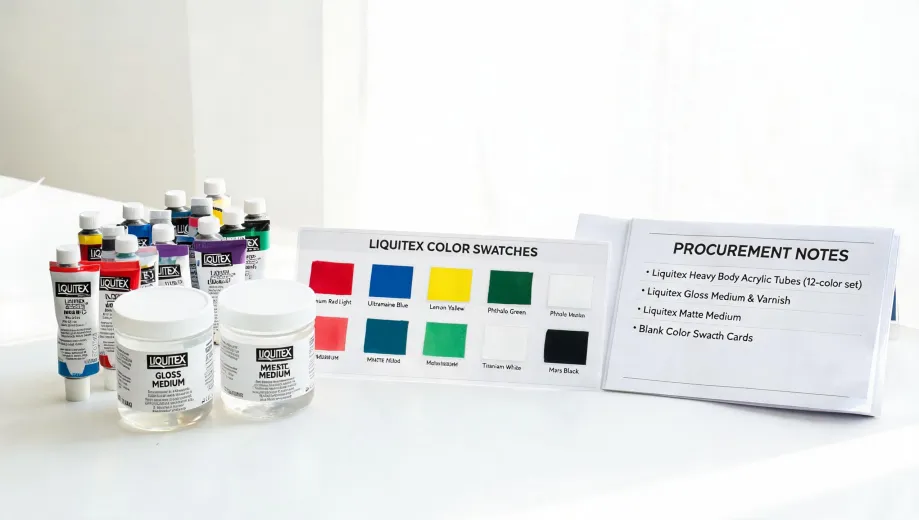
I'll say it plainly: most acrylic paint set reviews focus on the wrong thing. They talk about pigment load, color names, and professional-grade labels as if those are the only metrics that matter. But after four years of reviewing art supplies for school contracts, I've learned that consistency is the real quality test. That's exactly why I keep recommending Liquitex Basics acrylic paint sets for education and studio programs.
I'm a quality and brand compliance manager for a school and art supply distributor. I review every deliverable before it reaches customers—roughly 200 unique items annually. In Q1 2024, I rejected 9% of first submissions because the product didn't match the approved spec. That experience shapes every Liquitex Basics acrylic paint review I write.
My Strong Opinion
Liquitex Basics is not the most exciting acrylic paint you can buy. It's the most reliable one. For a classroom, a school district, or a young artist's first serious set, reliability matters more than pigment density. I'd argue that a student learns more from a paint that behaves consistently than from a premium paint that dries too fast or shifts color unexpectedly every other lesson.
Why Consistency Beats Pigment Load
We ran a simple internal test in 2023. We took two student-grade acrylic sets—one Liquitex Basics, one a popular craft brand—and painted identical color cards every week for a month. The Liquitex Basics bottles delivered nearly the same viscosity and drying time across all four weeks. The craft paint thickened noticeably by week two. We stored both sets the same way, so the difference came down to formulation.
From a compliance standpoint, that consistency is a spec issue, not an aesthetic opinion. When a teacher plans a 45-minute lesson, they need paint that handles the same on Tuesday as it did on Monday. This is the same reason I support digital inspection workflows: a standardized process removes variables. Fewer variables mean fewer failures. That's not a buzzword. It's a cost issue. In my experience, the efficient choice is the paint that needs the least troubleshooting. Liquitex Basics is that paint for most schools.
I saw the same effect when we switched our inspection forms to a digital workflow in 2022. We cut sign-off time from two days to four hours, and we eliminated the data-entry errors that used to cause rework. Standardizing art supplies is not exactly the same thing, but the principle holds: consistency reduces friction.
The Surprise: It's Not Always the Paint
Never expected the biggest quality complaint about bad student acrylics to come from the surface. But after working with school buyers, the pattern is clear: a lot of disappointed beginners are painting on copy paper. Copy paper is engineered for toner, not for water-based paint. It curls, it buckles, and it makes a mediocre paint look terrible. That's not a paint defect. That's a system mismatch.
This is also where I get annoyed by how-to guides that focus only on paper orientation and ignore the protocol. If you're searching for how to use a printer because you want to make acrylic transfers, the paper type setting changes how much toner sits on the sheet. Choosing a heavier paper type in the printer settings changes the result. Same concept with acrylics: the tool matters, but the protocol matters just as much.
A Lunch Box Analogy That Sounds Weird Until It Isn't
Here's an analogy I use with school buyers. A Bentgo lunch box is not glamorous. It's a plastic container with separate compartments. But when you're packing 30 meals, those compartments are the entire point. They standardize portions, make inspection faster, and reduce cross-contact. Liquitex Basics is like the Bentgo lunch box of acrylic paint sets. Every bottle in the acrylic paint set Liquitex makes is designed to work predictably with the others. You don't have to guess whether one color is thinner or faster-drying than the next. That predictability is what makes it safe to order in bulk, distribute across a district, and rely on in a syllabus.
What About the Student Grade Label?
I get the hesitation. Some artists wonder whether a student-grade paint can ever be good enough. Honestly, I used to assume student grade was just a polite way of saying watered down. I still kick myself for thinking that. Liquitex Basics has less pigment load than Liquitex Professional Heavy Body, but that's part of the design. It keeps costs down for classrooms while still offering the same color system and blendable consistency.
The surprise wasn't the lower pigment concentration. It's how little that mattered for actual use. In a classroom, a paint that flows evenly and intermixes cleanly is more useful than a heavy-body paint that requires a medium to get the same behavior. If a young painter wants to explore pouring or glazing later, that's what Liquitex Basics and the Basics acrylic mediums are for.
I've read a lot of Liquitex Basics acrylic paint reviews over the years. The negative ones usually mention pigment strength or the fact that the paint is not professional grade. The positive ones mention consistency and value. In my work, those positive comments match what we see in our quality checks.
Safety and Compliance: The Quiet Advantage
For schools, safety is a compliance issue, not a marketing issue. Most Liquitex Basics colors carry the AP seal from the Art & Creative Materials Institute. Per ACMI, an AP seal means the product contains no known hazardous materials in sufficient quantity to cause adverse health effects. That's a standard that matters when you're ordering for a shared classroom. I still tell buyers to check the label of every color, because some pigments may have specific warnings, but the across-the-board compliance position is far stronger than budget craft paint brands.
Per the Art & Creative Materials Institute, the AP seal is a recognized mark of safety for art materials. Check the current ACMI list before purchasing.— accessed January 2025
The Basics line also includes cadmium-free hues, which simplifies purchasing for schools with restricted pigment lists. That's another reason I see it on so many approved supplier lists.
Should You Just Buy Professional Paint?
If a professional artist wants maximum pigment load and longer working time, Liquitex Professional is a better fit. I'm not arguing that Basics replaces it. I'm arguing that a school should not buy professional paint for 30 students who are still learning color mixing. You'll get more waste, more frustration, and a bigger budget hit. The efficient choice is the paint that matches the task. That's why I keep steering education buyers toward the Liquitex Basics acrylic paint set and then adding a few open-stock bottles for advanced students.
Honestly, I'm not sure why some school buyers keep ordering bargain craft paint after seeing the failure rate. My best guess is that the initial price per bottle is easier to justify at budget time. But the true cost includes redoing lessons, replacing dried bottles, and losing class time.
Final Opinion
So here's my final view, and I'm not going to soften it: if you're choosing an acrylic paint set for a classroom, a studio program, or an art beginner, Liquitex Basics is the strongest recommendation I can make. It's not the most prestigious paint on the shelf. But it's the paint that shows up the same every time—and that reliability is what turns a good lesson into a repeatable one.
This was accurate as of January 2025. Product formulations and ACMI statuses can change, so verify current technical data sheets before you update a purchase order.

Elena Baptista
Elena Baptista is an office printing and imaging analyst covering laser and inkjet printers, multifunction devices, copiers, label and receipt printers, ink cartridges, toner cartridges, and drum units. She applies ISO/IEC 24734, ISO/IEC 24711, and ISO/IEC 19798 methods while comparing print speed, first-page time, duplex throughput, duty cycle, page yield, coverage assumptions, resolution, color consistency, energy use, and maintenance intervals. Her guides help offices, schools, dealers, and procurement teams match output volume, media handling, connectivity, consumable economics, service access, and fleet-management requirements.