Liquitex Acrylic Paint: Varnish, Color Charts, and Water-Based Paint—from the Person Who Orders It
-
Is Acrylic Paint Water Based?
-
What Is Liquitex Acrylic Gloss Varnish For?
-
How Do I Read the Liquitex Acrylic Color Chart?
-
What Printer Paper Size Do I Need for the Liquitex Color Chart?
-
Is Liquitex Worth the Price Compared to Cheaper Brands?
-
What's the Most Unexpected Thing I've Learned Doing This Job?
I'm the office administrator for a 400-person school district. I manage all the purchasing—roughly $180,000 a year across 12 vendors—and the art department's supply orders are a fair chunk of that. I report to both the operations director and the finance office, which means I have to defend every purchase twice. Since I took over purchasing in 2020, the teachers' questions about Liquitex have been remarkably consistent. Here's what they ask, and the answers I give them:
- Is acrylic paint water based?
- What is Liquitex acrylic gloss varnish for?
- How do I read the Liquitex acrylic color chart?
- What printer paper size do I need?
- Is Liquitex worth the price?
- What's the most unexpected thing I've learned?
Is Acrylic Paint Water Based?
Yes. Liquitex acrylics are water-based. The paint is an acrylic polymer emulsion, and water is the carrier. That's why you can thin them with water, clean brushes with soap and water, and blend colors on a damp palette. Once the water evaporates, the paint cures into a water-resistant film. That's a feature for finished artwork, but it means you can't rescue a brush after the paint dries in the ferrule. I've tested that theory more than once.
"Water based" gets thrown around as a selling point, though. Per FTC guidelines (ftc.gov), a claim like "non-toxic" or "safe for kids" has to be substantiated—not just printed on the front label. When I buy for classrooms, I request the Safety Data Sheet from the vendor. It's boring, but it's the only way finance will approve the order, and honestly, it's the right way to check whether a product belongs in a room with 12-year-olds.
One nuance: water based doesn't mean reworkable. Once acrylics dry, they're permanent. You can paint over them, but you can't lift them with water. That's exactly why teachers like them for student work, but it's worth knowing before you buy an expensive set for the wrong purpose.
Liquitex's main acrylic lines are heavy body (thick, holds brush strokes), soft body (fluid, good for glazing), and basic (student-grade). All of them are water based. If you're new to ordering, "heavy body" and "soft body" describe the consistency, not the quality—both come in professional grade.
What Is Liquitex Acrylic Gloss Varnish For?
Gloss varnish is a clear protective coating applied over a finished acrylic painting. The "gloss" in the name means it dries shiny, which saturates colors and gives the surface a polished, professional look. Liquitex also makes satin and matte versions, but gloss is what our teachers ask for most because it makes student work look like it belongs in a gallery instead of a hallway.
I went back and forth between gloss and satin for about two weeks when I first started ordering in 2020. Gloss offered deeper color saturation; satin handled glare better under the fluorescent lights in our corridors. Ultimately I chose gloss because the teachers said it made the work look "finished"—but I still stock satin for rooms with big windows.
There's also permanent vs. removable varnish. Liquitex Soluvar is a removable varnish, which is what conservators tend to prefer because it can be taken off without damaging the painting. For a standard classroom, a permanent varnish is fine and costs less. If you're buying for a serious art program that shows work off campus, the removable option is worth discussing.
Application matters too. I order brush-on varnish because it's easier to store than spray cans and doesn't require the same ventilation. In a school supply closet, that's not a small thing.
How Do I Read the Liquitex Acrylic Color Chart?
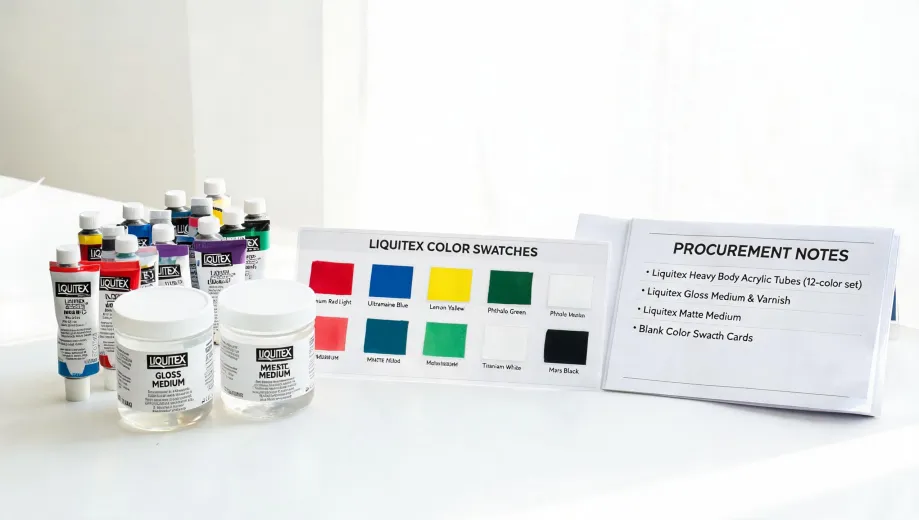
The color chart is the most useful ordering tool on the Liquitex site, and not enough people use it. Every color is listed with its pigment code, opacity rating, lightfastness score, and series number. When a teacher says "get the same blue we used last year," I don't try to remember—I find the code (PB15 is Phthalocyanine Blue, PB29 is Ultramarine) and reorder the exact same code. That's how you get matching colors across different orders.
The chart also marks which colors are in Liquitex's cadmium-free range. They color-matched those to the traditional cadmium hues, which matters in classrooms. But the opacity rating matters too: a semi-transparent color behaves differently than an opaque one, even if they're the same hue. And the series number is a pricing tier based on pigment cost—it's not a quality rating. If you're on a budget, the chart lets you find similar colors in lower series.
I'd keep a printed chart in the art room. Students can hold it against their work, which is faster than scrolling through a PDF on a tablet.
What Printer Paper Size Do I Need for the Liquitex Color Chart?
The Liquitex color chart PDF is formatted for US letter size: 8.5 × 11 inches (ANSI A). That's the same size as the physical chart, so the proportions match. Outside the US, A4 (210 × 297 mm) prints fine, but it's slightly narrower and taller, so the layout shifts a little.
To be fair, this is where I learned a paper-size lesson the hard way. In 2022, I mailed about 40 printed charts to schools in our region. An unfolded 8.5 × 11 sheet doesn't fit in a standard letter envelope. USPS defines letters as up to 6.125 × 11.5 inches; anything bigger counts as a "flat" and costs more to mail (Source: USPS Business Mail 101, usps.com). I've used the right postage ever since.
Also, when you print the chart, check that the printer is set to "actual size" rather than "fit to page." Otherwise the swatches get slightly shrunk, and then the whole point of comparing colors is off. Small thing, but it comes up more often than you'd think.
Is Liquitex Worth the Price Compared to Cheaper Brands?
This question comes from finance more than from teachers, and my honest answer is: sometimes yes, sometimes no. People assume expensive paint costs more because the brand is famous. I think the causation runs the other way—Liquitex can charge more because their formulas have been consistent for a long time. That consistency is worth money when 30 students are all using the same color at the same time.
But I do not recommend Liquitex for every single classroom. If the project is a quick exercise and the results don't need to last, a student-grade paint is probably fine. Liquitex has its own basic line, and I order that for introductory classes.
I'll also note that our procurement rules require approved vendors, so the cheapest quote on paper isn't always the cheapest once you count shipping, backorder delays, and the time I spend reconciling invoices. That's a real cost, even if it doesn't show on the receipt.
Granted, cheap paint has hidden costs. Lower-priced brands often have inconsistent pigment loads, so different tubes in the same batch can look slightly different on the canvas. If that inconsistency drives teachers crazy, professional grade is worth the budget. If not, there's nothing wrong with saving the money. No single brand is the best for every situation.
What's the Most Unexpected Thing I've Learned Doing This Job?
That buying art supplies isn't that different from buying anything else for a school district. One week HR asked me to find a body fat percentage calculator for the staff wellness fair. The same week, I ordered 12 bottles of Liquitex acrylic gloss varnish for the high school art room. On the surface, those purchases have nothing in common. Underneath, they're the same kind of decision.
For both, I had to read the specs, understand what the numbers actually tell you, and decide whether the price made sense for the school. A body fat percentage calculator is only useful if the person using it understands the margin of error. A gloss varnish is only useful if the painting underneath was prepped well. The tool—or the paint—doesn't do the work by itself.
So that's my five-year summary: know what you're buying, know who's using it, and keep the paperwork straight. When in doubt, ask the art teachers. They'll tell you exactly what they need. My job is just to make sure it arrives.

Elena Baptista
Elena Baptista is an office printing and imaging analyst covering laser and inkjet printers, multifunction devices, copiers, label and receipt printers, ink cartridges, toner cartridges, and drum units. She applies ISO/IEC 24734, ISO/IEC 24711, and ISO/IEC 19798 methods while comparing print speed, first-page time, duplex throughput, duty cycle, page yield, coverage assumptions, resolution, color consistency, energy use, and maintenance intervals. Her guides help offices, schools, dealers, and procurement teams match output volume, media handling, connectivity, consumable economics, service access, and fleet-management requirements.