Liquitex Acrylic Paint: How to Match the Right Body to Your Project (Without Wasting Budget)
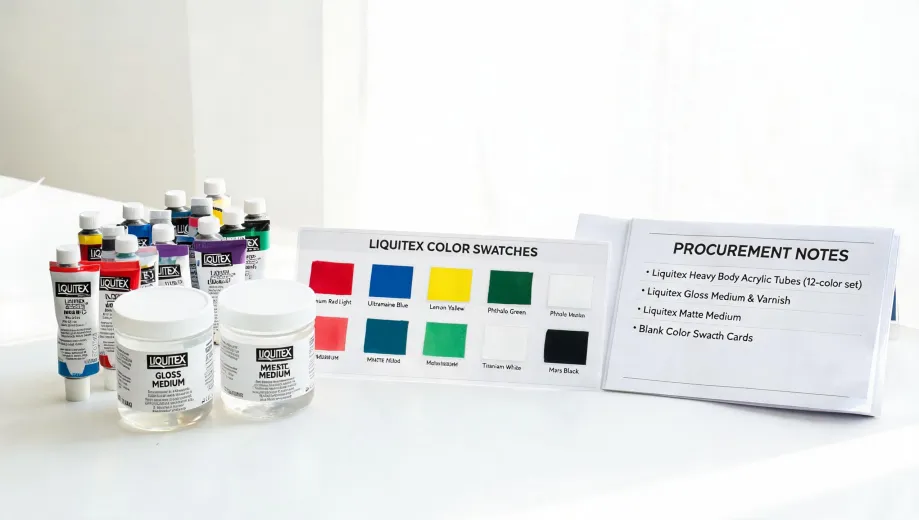
-
There's no "best" Liquitex paint—just the right one for your situation
-
How to think about acrylic paint bodies
-
Scenario A: The professional artist working on canvas (heavy body territory)
-
Scenario B: The mixed media illustrator or paper worker (soft body wins)
-
Scenario C: The design student or budget-conscious buyer (acrylic gouache as a wildcard)
-
The hidden cost dimension: beyond the tube price
-
How to decide which Liquitex paint suits your project
There's no "best" Liquitex paint—just the right one for your situation
When I first started stocking art supplies for our institution back in 2017, I assumed heavy body acrylic was always the superior choice. Thicker paint equals better quality, right? That assumption cost us about $1,200 in wasted inventory over two semesters. Students struggled with texture, mediums didn't mix as expected, and I had instructors complaining about "buttery" paint on projects that needed fine line work.
Here's the thing: Liquitex makes several acrylic formulations for a reason. Heavy body, soft body, gouache, inks—each has a specific job. The question isn't "which is better?" The question is "which fits your application?"
In this guide, we'll break down three common scenarios and match them to the right Liquitex product line. I'll also share what I learned after ordering 200 tubes of the wrong type—and how to avoid that mistake.
How to think about acrylic paint bodies
Before we dive into scenarios, here's the simple framework: acrylic paint's "body" refers to its viscosity and how it holds its shape. Heavy body is thick like soft butter. Soft body is smooth, almost like yogurt. Acrylic gouache has a matte finish with medium viscosity. Liquitex also offers flows (inks) and spray paint, but we'll focus on the three main types for this article.
Key factors that should drive your choice:
- What surface are you painting on? Canvas holds heavy body well. Paper and illustration board often need thinner paint.
- What technique are you using? Impasto needs heavy body. Washes and glazes need soft body or ink.
- What's the intended finish? Matte, gloss, satin—each product line offers different sheen levels.
- Budget and coverage: Heavy body costs more per ounce but covers more area in thick applications. Soft body is cheaper but thinner.
Not exactly rocket science, but people get it wrong more often than you'd expect. Let me show you how.
Scenario A: The professional artist working on canvas (heavy body territory)
If you're creating fine art on stretched canvas, especially if you use palette knives or work in impasto style, reach for Liquitex Heavy Body Acrylic. This is the classic choice for a reason: it holds peaks, blends smoothly, and dries with a rich, buttery feel that retains brush and knife marks.
What I learned the hard way: In 2018, an instructor requested "student-grade acrylics" for a painting foundations class. I ordered soft body to save money. Big mistake. The students couldn't build texture, their strokes flattened out, and the paint didn't hold up to scraping and layering techniques. We ended up spending $380 on heavy body replacements mid-semester. The soft body tubes we had left went to printmaking, where they worked fine. The lesson: don't substitute body types to save 15%.
Best use cases for Liquitex Heavy Body:
- Impasto and palette knife work
- Large-scale canvas paintings
- Projects requiring distinct brush marks or texture
- Mixing with heavy body mediums (modeling paste, texture gels)
Where it falls short: Detail work, airbrushing, smooth washes, and fine line illustration. Heavy body is too thick for these applications unless you thin it with medium—which adds cost and changes handling.
Scenario B: The mixed media illustrator or paper worker (soft body wins)
For artists working on paper, illustration board, or mixed media surfaces, Liquitex Soft Body Acrylic is often the better choice. It flows smoothly, doesn't sit on top of the paper, and handles more like watercolor or gouache in terms of application.
I remember a graphic design instructor telling me, "I don't need paint that stands up. I need paint that goes down smooth." She was doing detailed line work and washes on hot-press paper. Heavy body was a nightmare for her—she had to thin everything, which diluted color intensity. Soft body went on in one clean coat.
Best use cases for Liquitex Soft Body:
- Illustration and fine line work
- Watercolor-style washes and glazes
- Airbrushing (requires minimal thinning)
- Mixed media collages and layering with paper
- Fabric and textile painting (softer hand feel)
The twist that surprised me: Soft body actually covers more surface area per tube than heavy body when used for flat, thin applications. If you're doing a lot of background washes or color blocks, soft body may be more economical. I calculated this after noticing our heavy body lasted half as long in certain classes. A 4-ounce tube of soft body covers about 8-12 square feet for a wash application; heavy body covers 3-5 square feet for a medium-thick coat. Factor in your technique, not just the label price.
What to watch for: Soft body can drip on vertical surfaces. It also dries slightly faster than heavy body in thin layers, so wet-on-wet blending requires quick work.
Scenario C: The design student or budget-conscious buyer (acrylic gouache as a wildcard)
Here's where the conventional wisdom gets challenged. Most people think gouache is for illustration only. But Liquitex Acrylic Gouache deserves a closer look, especially if you're working on a tight budget or need specific finishes.
Look, I'm not saying gouache replaces heavy body or soft body. But for beginner classes, design mockups, and student portfolios, acrylic gouache offers something useful: it dries completely matte, has great opacity (so less layering needed), and costs noticeably less per tube than professional heavy body.
For comparison, in early 2025, a 75ml tube of Liquitex Heavy Body runs around $12-16. The same size in acrylic gouache is $7-10. For a class of 20 students doing basic color theory exercises, that difference adds up fast: roughly $100-150 saved per class set. Not a small number when you're managing a departmental budget.
Where acrylic gouache really works:
- Design presentations and concept work (matte finish photographs well)
- Color theory exercises (high opacity means less waste)
- Student portfolios on paper or illustration board
- Projects requiring flat, even color blocks without visible brush strokes
- Mixed with line work or markers (it layers cleanly)
Where it doesn't work: Canvas painting at scale (too thin for impasto), outdoor murals (not designed for weather resistance), pieces requiring high gloss finish. Also, acrylic gouache reactivates slightly when rewet—not as much as traditional gouache, but enough that layering thick wet coats can lift the base layer.
The hidden cost dimension: beyond the tube price
I'm a big believer in total cost thinking, especially for institutional purchases. Here's what I've learned about the real costs of choosing the wrong Liquitex body:
- Waste cost: Buying heavy body when soft body would do means you get fewer finished pieces per dollar. Student projects need coverage, not texture.
- Medium cost: Thinning heavy body with medium to get soft body consistency adds $2-5 per project in medium costs. You're better off buying soft body directly.
- Time cost: Artists who fight their paint waste time. A 3-week project where the first week was spent adjusting paint consistency is not efficient.
- Replacement cost: Scrapping 50 student projects because the paint was wrong for the surface—I've been there. It's not just money; it's lost learning time.
The cheapest paint per tube is rarely the cheapest per finished piece. Calculate coverage, not just unit price.
How to decide which Liquitex paint suits your project
Here's a simple decision framework I now use before any large order:
- What's the primary surface? Canvas → heavy body (or soft body if thin washes are the goal). Paper/board → soft body or acrylic gouache. Mixed media → soft body for flexibility.
- What's the dominant technique? Palette knife/impasto → heavy body. Washes/glazes → soft body or ink. Flat illustration → gouache or soft body.
- What's the budget per student or project? Under $7/tube → acrylic gouache is the most practical option. $10-15/tube → heavy body for canvas work, soft body for paper. Over $15/tube → you're in professional heavy body territory, and that's fine if the work justifies it.
- What finish do you need? Matte → acrylic gouache or soft body with matte medium. Gloss → heavy body with gloss medium or gloss varnish. Satin → soft body with satin medium.
One more thing: don't ignore the Liquitex Basics line for student work. It's lower pigment load and less color range, but at roughly $4-6 per tube, it's a solid entry point for color theory and practice work. Upgrade to professional grade (Heavy Body, Soft Body, or Gouache) once techniques are established. I've found Basics handles about 70% of student needs; the premium lines add archival quality and pigment intensity that matter for finished pieces but not for exercises.
If you're still uncertain, order sample tubes of three bodies. Compare them on the same surface. The right choice becomes obvious in five minutes of testing. That's $30 well spent compared to $300 on the wrong product.
Prices as of early 2025 based on major online art supplier listings; verify current rates before ordering.
Elena Baptista
Elena Baptista is an office printing and imaging analyst covering laser and inkjet printers, multifunction devices, copiers, label and receipt printers, ink cartridges, toner cartridges, and drum units. She applies ISO/IEC 24734, ISO/IEC 24711, and ISO/IEC 19798 methods while comparing print speed, first-page time, duplex throughput, duty cycle, page yield, coverage assumptions, resolution, color consistency, energy use, and maintenance intervals. Her guides help offices, schools, dealers, and procurement teams match output volume, media handling, connectivity, consumable economics, service access, and fleet-management requirements.