Liquitex Acrylic Medium Gloss and Metallic Paint: A Quality Inspector’s Purchasing Checklist
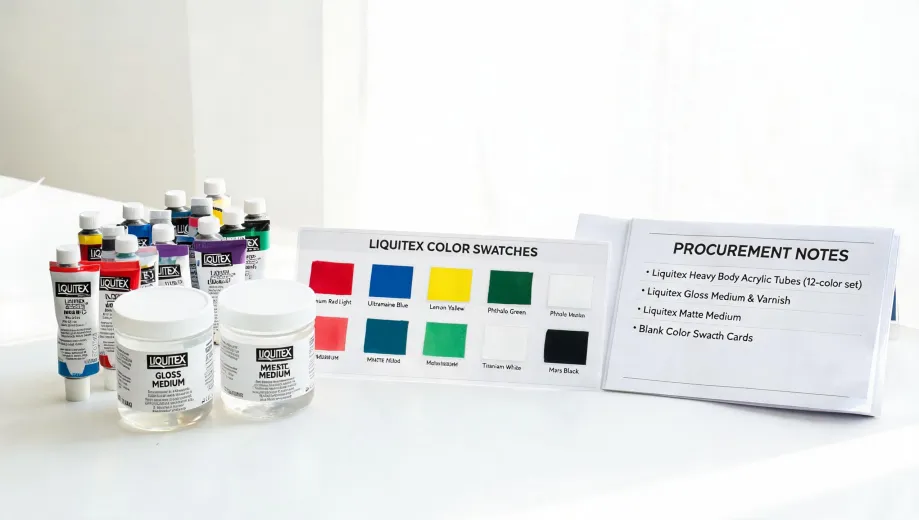
Order the Liquitex acrylic medium gloss before you order the Liquitex metallic acrylic paint. That sounds like a minor stocking detail, but after years of checking art supplies before they reach classrooms and stores, I can tell you that this one decision prevents more acrylic complaints than almost any other. The metallic paint is the exciting part; the gloss medium is the control. And if you are the person approving the order, put an ergonomic office chair on the same requisition. I am not joking. Quality problems in an art program rarely start with a bad bottle; they start with a room that makes careful testing impossible.
Let me state my bias so you know where this comes from. I am a quality and brand compliance manager for an art-materials distributor serving schools and retail accounts. I review roughly 300 unique products per year — paint, mediums, brushes, paper, and accessories — before they are approved for delivery. In 2025, I have rejected about 7% of first shipments for pigment separation, incorrect labels, off-spec viscosity, or damaged packaging. I do not get to decide what looks good. I get to decide whether what arrives on the loading dock matches what was specified on the purchase order.
Why gloss medium before metallic paint
Everything I have read from art marketing says the pigment is the star. In practice, most of our classroom complaints came from the clear bottles. A teacher would take Liquitex metallic acrylic paint, add tap water to make it flow, and then blame the paint when the sheen died. Water is the issue. Acrylic paint is pigment suspended in a polymer binder. Tap water dilutes that binder and makes the metallic flakes dry unevenly. Liquitex acrylic medium gloss is basically an unpigmented acrylic binder. It lowers the paint’s viscosity and increases the gloss of the film without destroying adhesion. That is why I call it the control product. Buy it before it is needed, and you eliminate a whole category of failure.
What Liquitex acrylic medium gloss actually does
Liquitex acrylic medium gloss is a clear liquid that does three useful jobs on a school order:
- It extends the paint. A small amount of gloss medium makes the paint go further while keeping the binder strong.
- It improves flow. Students often struggle to lay down smooth metallic washes. The medium helps the paint move without breaking down the film the way extra water does.
- It increases gloss. The medium adds a reflective quality to the dried surface, which is especially useful when you are working with metallic pigments.
That does not mean more is better. If you pour too much medium, you dilute the pigment concentration and the metallic effect looks thin. On our test bench, we start with something close to one part medium to three or four parts metallic paint, depending on the project. Then we dry a test swatch before mixing a larger batch. The numbers matter less than the habit of testing before production.
The mistake I see most often
A clear bottle says medium gloss, so many buyers use it as a final varnish. Do not do that. A medium is not a varnish. A varnish is designed to sit on top of the finished paint film and remain removable in the future. A medium becomes part of the film. If you use gloss medium to seal a finished painting, you will not be able to remove it safely later without damaging the work. Liquitex sells varnishes for that purpose.
What I check before releasing Liquitex metallic acrylic paint
Liquitex metallic acrylic paint is a special case because metallic pigments behave differently from regular pigments. The sheen usually comes from mica particles, not from simple dye or earth pigments. Those particles settle, and shipping can change how the paint behaves. Here is what I inspect on every batch:
- Separation. If there is clear liquid sitting on top, the batch needs a careful stir, not just a shake. Packed pigment at the bottom is not automatically a failed batch, but it must be remixed and tested before it goes to a classroom.
- Drawdown. We apply a thin, uniform layer on prepared board and check the sheen at an angle. Overhead light alone hides streaking. Metallic paint can look perfect from one direction and patchy from another.
- Drying time. Sheen changes as the acrylic film dries. We wait at least 24 hours before signing off a delivery.
Label and compliance check
Schools also ask about cadmium-free formulas. Liquitex does offer cadmium-free formulations, but cadmium-free is not the same as food-safe or completely non-toxic in every color. On a B2B order, require the AP or CL seal and a safety data sheet for each SKU. If a supplier says all acrylics are safe, ask them to show the certificate. A generic statement does not satisfy a school district’s compliance review.
Three overlooked line items on the same purchase order
The paint and medium will only perform as well as the system around them. That is why our buying checklist includes three non-glamorous line items.
A4 paper size for test swatches
Color and gloss testing need a consistent support. Outside the US, the default standard is the A4 paper size: 210 by 297 mm under ISO 216. If you are in the US, keep Letter size at 8.5 by 11 inches. The important thing is consistency. Do not let one supplier send A4 and another send Letter when you are comparing metallic paint finishes. Also, do not judge gloss on ordinary copy paper if students will be painting on canvas or board. The actual painting surface changes the sheen because absorbency and texture affect how acrylic dries.
What is a fountain pen? A compatibility trap
Fountain pens belong in the drawing section, not the acrylic paint section. A fountain pen is a writing instrument with a nib, a feed, and an ink reservoir. The feed uses capillary action to pull low-viscosity ink down to the nib. It is designed for liquid ink, not for thick acrylic paint. If someone dips a fountain pen into Liquitex metallic acrylic paint, the paint will dry inside the feed and ruin the pen. Use proper fountain pen ink for line work. If students need a permanent line under acrylic, use a waterproof technical drawing pen or a pigment-based marker instead.
The ergonomic office chair on the art order
The ergonomic office chair sounds unrelated, but it is part of quality control. Someone has to sit down, open boxes, compare swatches, read batch numbers, and write up problems. If that person is uncomfortable, the inspection gets rushed. In 2022, I replaced the old seats at two inspection stations with adjustable ergonomic office chairs. The inspection time went up slightly, but the defect rate in final review dropped because nobody was hurrying to get out of the chair. A height-adjustable chair with lumbar support and armrests is not a luxury purchase. It protects the person whose attention is the last filter before a school order ships.
When I would skip this advice
Not every acrylic project needs professional metallic paint and a separate gloss medium. Some one-hour paint-along sessions and crafts are fine with a basic student acrylic set. And if the plan is to show heavy body brushstrokes, adding medium is not the right move because it changes the body of the paint. The medium is a solution for flow, extension, and gloss control, not a universal additive.
The bigger boundary is delivery timing. Acrylic paint is a temperature-sensitive product. If a shipment sits in a cold warehouse, the acrylic emulsion can separate or freeze. A school has a semester schedule that cannot wait for resupply. That is why our contracts now specify delivery temperature and exact arrival windows. If a supplier cannot guarantee the date and the handling conditions, no discount is worth the risk. In an emergency, paying for rush delivery is not wasted money; it is buying certainty. And in quality control, certainty is part of the specification.

Elena Baptista
Elena Baptista is an office printing and imaging analyst covering laser and inkjet printers, multifunction devices, copiers, label and receipt printers, ink cartridges, toner cartridges, and drum units. She applies ISO/IEC 24734, ISO/IEC 24711, and ISO/IEC 19798 methods while comparing print speed, first-page time, duplex throughput, duty cycle, page yield, coverage assumptions, resolution, color consistency, energy use, and maintenance intervals. Her guides help offices, schools, dealers, and procurement teams match output volume, media handling, connectivity, consumable economics, service access, and fleet-management requirements.