Liquitex Acrylic Ink vs Paint Sets: Which Actually Saves You Money? A Procurement Manager's Honest Breakdown
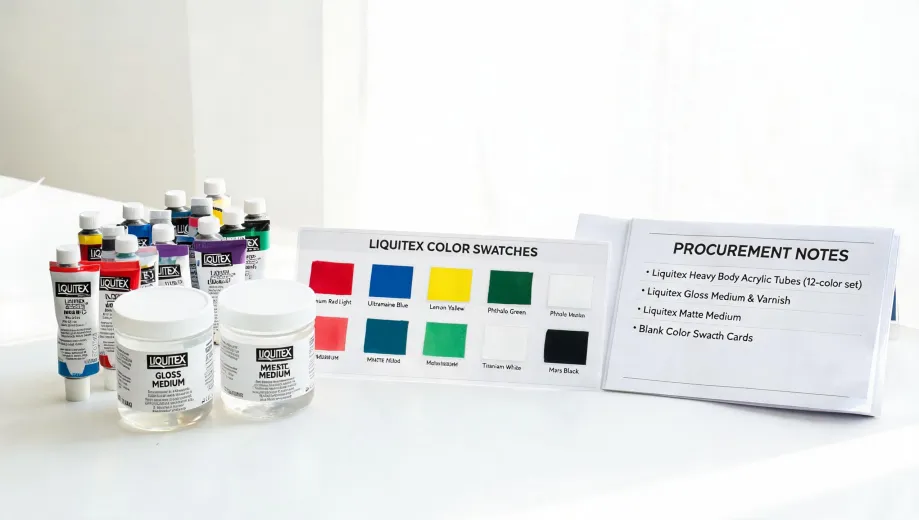
Here's the short answer: a Liquitex acrylic paint set beats Liquitex acrylic ink on cost per millilitre in every comparison I've run over six years of tracking art supply orders—but the ink is still the better buy for specific jobs, because no amount of paint will do what it does. If you're stocking a classroom, get the set. If you're an illustrator who needs intense staining washes and fine-line flow, get the ink and don't feel guilty about the price. The trick is knowing which situation you're in.
Why trust my numbers
I'm the procurement manager at a 40-person design studio in Chicago, and I manage a $45,000 annual budget for art materials. I've negotiated with 20+ vendors over the years and documented every order in our cost tracking system. Maybe 60 or so Liquitex orders to date—I'd have to check the spreadsheet for the exact count.
Every order gets logged with price, volume, and cost per millilitre. I built a CPM calculator for our team—cost per millilitre—because comparing paint by shelf price is a trap. It takes the total price, including shipping, and divides by the total volume. Sounds obvious, but you'd be surprised how many "bargain" orders stop making sense once shipping appears as a separate line item.
The spreadsheet numbers
From our last supplier order in January 2025 (verify current prices before buying):
- Liquitex acrylic ink, 30 ml bottle: roughly $14–18 → about $0.47–0.60 per ml
- Liquitex heavy body paint, 59 ml tube: roughly $9–13 → about $0.15–0.22 per ml
- Liquitex acrylic paint set, 12 × 22 ml tubes: roughly $25–35 → about $0.09–0.13 per ml
So on pure CPM, the set crushes the ink—by a factor of four to five. But I learned the hard way that this comparison doesn't tell the whole story.
What makes ink different from paint
Liquitex acrylic ink isn't watered-down paint. It's a fundamentally different formulation: finer pigment particles suspended in a low-viscosity acrylic binder, with some dyes added in certain colors. The pigment load is way higher than their soft body line. That's why it costs more per ml, and why it behaves differently.
In my first year as a buyer, I made the classic specification error: assumed "it's all liquid acrylic" meant fluid acrylics could replace the ink. Cost me about $700 in redo work when our lead illustrator's commissioned pieces came out flat. The washes didn't penetrate the paper like ink does—they just sat on the surface looking like weak watercolor left out too long. Like most beginners, I thought viscosity was the only difference. It wasn't. It was particle size.
That same year, I nearly made an even worse call. I knew I should get written confirmation on a rush order from a new vendor, but thought "we've worked with them for months, what are the odds?" The odds caught up with me: the verbal agreement got forgotten, and we lost a week of production waiting on "pending approval." Now our procurement policy requires written confirmation for any order over $500, no exceptions.
When the paint set is the smart choice
For classrooms, workshops, and anyone needing color variety on a budget, the Liquitex acrylic paint set is genuinely the right call:
- Lowest per-ml cost in the Liquitex lineup
- Twelve colors without committing to big tubes you might never finish
- One line item on a purchase order—no hidden extras
We order the 12-pack Basics set for our community workshops. Over six years of quarterly orders, it works out to roughly 35% less per tube than buying individually. I should add that our distributor gives education pricing, which widens the gap further.
The most frustrating part of comparing paint sets across vendors: the same listing title can hide different contents. "12 colors" on one site might be their basic range; on another, professional. Always check individual color names and lightfastness codes before comparing prices. That's a lesson from comparing eight vendors over three months using our TCO spreadsheet—which only exists because one vendor's "free setup" offer ended up costing us $450 in undisclosed fees.
When the ink is worth every cent
For illustration, fine-line work, airbrushing, and any project that needs crisp detail with saturated color, the ink is not a luxury—it's the correct tool. The flow properties mean you don't have to add water or medium, which keeps the pigment-binder ratio intact.
Our illustrator uses Liquitex acrylic ink for dip-pen linework where brush control with heavy body paint is nearly impossible, airbrushing because it's the right consistency without thinning agents, and washes on raw canvas where fine pigment particles penetrate the fibers.
In those applications, the CPM comparison becomes a red herring. The real alternative is buying separate airbrush medium and extra pigment, losing labor hours, and still not matching the ink's performance. Way more expensive than the ink premium. I made this case to our CFO in Q2 2024 when the budget variance report flagged our ink spending. After walking her through the alternative costs, she approved a larger ink line item the next fiscal year, no questions asked.
A short detour into history, because it explains the price
Liquitex commercialized the first water-based acrylic paint in 1955. That's in the same historical ballpark as the question of who invented the fountain pen—Petrache Poenaru's 1827 patent is the usual answer, though earlier devices existed. Both stories show that what feels like a simple tool is actually the result of many decades of iteration.
That heritage matters for purchasing. After seventy years of refining the same product category, inter-batch color consistency is reliable. Industry standard color tolerance is Delta E < 2 for brand-critical colors, and Liquitex's professional line consistently lands in that range—which is why we spec it as the default for client work requiring exact color matching.
This also matters if you're working with printed materials: the same Pantone references that guide our print vendor's color management align with the color expectations we set in paint. One system, less mismatch risk.
Why a single calculation only takes you so far
Here's an analogy I use to explain our evaluation process: using an ABV calculator tells you the alcohol content of a beer, but nothing about how it tastes. ABV—alcohol by volume—is one useful number, not the whole picture. Cost per millilitre is the same for art supplies: a necessary starting point, but not the final answer.
Pigment strength, inter-batch consistency, lightfastness ratings, and supplier support don't show up in the unit price. A cheaper paint might need two extra coats, doubling labor cost. Mismatched batches mean repainting, which clients notice. Fading artwork is a reputation problem, not just a materials one. I've learned to ask what's NOT included before asking what's the price—the vendor who lists everything upfront, even if their total looks higher, usually costs less in the end.
When you should skip Liquitex entirely
Craft projects with no archival requirement don't need professional-grade pigment. Student paint will do the job. Large-surface coverage like murals and stage sets will eat your budget on per-ml cost—buy bulk display-grade paint and keep Liquitex for detail work. Heavy texture applications? Ink isn't the answer; use heavy body paint. And if you're on a tight budget, craft-store acrylics will handle plenty of hobby uses. Upgrade when their limitations actually frustrate you, not because a marketing campaign tells you to.
This last point usually surprises people. But procurement is about honesty, not brand loyalty. Liquitex is our default spec for professional projects because the data supports it—not because it's the only brand that works. We've tested Golden and Winsor & Newton alongside Liquitex, and they're all strong lines. Golden's heavy body has a buttery feel some of our painters prefer for knife work. Liquitex wins for us on price-to-performance and consistency, but that's a conclusion for our use case, not a universal ruling.
One more caveat: some specialty colors contain heavy metals and require proper handling—always check the safety data sheets before pushing paint into classrooms. "Cadmium-free" lines are great, but read the label for each color.
Prices as of January 2025; check your local distributor for current quotes.

Elena Baptista
Elena Baptista is an office printing and imaging analyst covering laser and inkjet printers, multifunction devices, copiers, label and receipt printers, ink cartridges, toner cartridges, and drum units. She applies ISO/IEC 24734, ISO/IEC 24711, and ISO/IEC 19798 methods while comparing print speed, first-page time, duplex throughput, duty cycle, page yield, coverage assumptions, resolution, color consistency, energy use, and maintenance intervals. Her guides help offices, schools, dealers, and procurement teams match output volume, media handling, connectivity, consumable economics, service access, and fleet-management requirements.