3 Scenarios for Choosing Liquitex Acrylics (And How to Avoid My Mistakes)
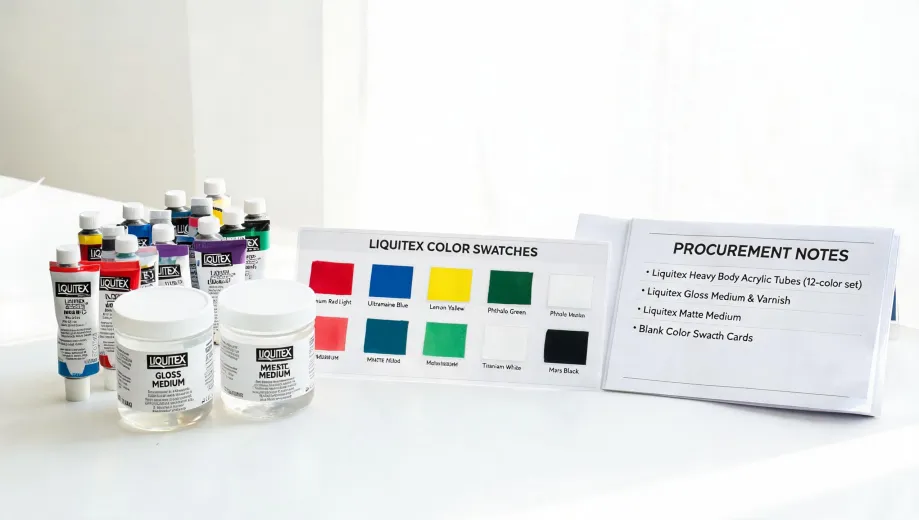
There’s No Single “Best” Liquitex Line
When I first started handling material orders for our community college’s art department back in 2017, I assumed the answer was simple: buy the most affordable option. Liquitex Basics acrylic paint was cheap, students could use it without stressing about cost, and everyone would be happy.
I was completely wrong.
Within two semesters, I had a studio coordinator angry about thin coverage on canvas, a budget committee questioning why we’d spent extra on a product that didn’t perform, and a stack of returned Basics sets that nobody wanted to use. I learned the hard way that “acrylic paint” is not one product—it’s a family. And if you don’t know which branch you need, you’re going to waste money.
To save you the same headache, I’ve broken this down into three common scenarios. Your choice depends entirely on what you’re actually painting and who’s using it.
Scenario A: The Student / High-Volume Classroom (Basics Line)
If you’re equipping a classroom where students are learning color theory, mixing exercises, or basic technique—and the paint is going to be used up quickly—Liquitex Basics is the right call. But only if you know its limits.
My mistake? I assumed “basic” meant “good enough for everything.” It’s not. The Basics line has lower pigment load and more filler. It works great for practice pieces, underpainting, or projects where the final result doesn’t need to be archival. But if a student tries to lay down a solid white block on unprimed canvas with Basics alone? They’ll be layering three coats and still seeing the weave.
Here’s what I do now: For classrooms, I order a mix—80% Basics for bulk exercises, and 20% Professional Heavy Body for the critical colors (white, black, primary red) that need more punch. That split saved us about 35% in material costs versus going full professional, and the complaints stopped.
Oh, and one thing I had to learn the hard way: how to erase permanent marker from Liquitex basics samples after a student accidentally labeled a wet painting. A little rubbing alcohol on a cotton swab works. Just don’t scrub too hard or you’ll lift the paint layer.
Pricing reference (as of January 2025): a 75ml tube of Liquitex Basics acrylic paint runs about $4–$6 depending on color. The same size in Professional Heavy Body is $10–$14. The savings are real, but so is the quality gap.
Scenario B: The Professional Artist / Gallery Work (Professional Heavy Body)
For artists who are selling their work or exhibiting, Professional Heavy Body is the standard. It’s thick, holds brush strokes, and has the pigment density to cover in one coat. If you’re working on a piece that needs to last, this is non-negotiable.
But here’s where I nearly made a different mistake: assuming every professional artist wants the same thing. One of our faculty members, a watercolorist transitioning to acrylics, hated the texture of Heavy Body. She found it too stiff for her style. That’s when I realized there’s another branch to this tree.
When heavy body isn’t the answer: If the artist wants fluid washes, thin glazes, or airbrush work, Liquitex Professional Soft Body is the better choice. It’s the same pigment load as Heavy Body, but the consistency is smooth and fluid—almost like thick cream. It won’t hold a peak, but it’s perfect for abstract work or blending.
To be fair, you can thin Heavy Body with water or medium, but you’ll lose some of the binder and the paint may become less stable. That’s why I recommend Soft Body for fluid techniques and Heavy Body for impasto. Don’t force one tool to do everything.
If you’re managing an artist studio and the budget is tight, I get it—I’ve been there. But cutting corners on professional-grade materials for paying-commission work is a penny-wise, pound-foolish move. I once saw an artist try to use Basics for a gallery submission. The result was flat, patchy, and they had to redo it on Professional at double the material cost. Saved $20 on paint, wasted $40 and 15 hours.
Scenario C: The DIY Enthusiast / Mixed Media (Acrylic Mediums & Liquitex Gloss)
This is the scenario most people overlook. You’re not a student. You’re not selling art. You’re someone who wants to erase permanent marker from a plastic palette after a weekend project, or finish a decorative piece with a shiny, protective coat.
This is where the Liquitex acrylic medium gloss becomes the star. Mediums let you change the texture, drying time, and finish of your paint without changing the pigment load. If you’re working on a pour painting or a collage, a gloss medium can give you that glass-like finish that makes the piece look “professional” without needing expensive paint.
I’ll admit: in my first year, I thought mediums were a waste. “Just use water,” I told myself. Then I tried to varnish a mixed-media piece with diluted Basics, and it cracked. That’s when I started paying attention to the Liquitex medium line.
Quick tip for the DIY crowd: If you need to erase permanent marker from a non-porous surface like glass or acrylic sheeting, a dry-erase marker applied over the permanent markings can help loosen them. But this is a tangent. The real point is: mediums expand what your paint can do, and they’re often cheaper than upgrading to a premium paint line.
By the way, if you’re trying to figure out material cost for a project, use a percentage decrease calculator to find a 20% off sale price on a $50 set. That’s the kind of math I do in my head now, but I still keep a calculator open on my phone. A 20% decrease on $50 is $40. That savings can buy a small tube of medium.
How Do You Know Which Scenario You’re In?
Here’s my simple test. Ask yourself three questions:
- Who is using this paint? A student who will use 10 colors in a semester? Go with Basics. An artist who needs archival quality for a show? Professional Heavy Body.
- What is the technique? Thick impasto or brush-textured work? Heavy Body. Thin washes or airbrush? Soft Body or a medium like Liquitex Gloss.
- What is the surface? Canvas primed for acrylic? Most lines work. Non-porous surfaces like plastic or glass? You’ll need a medium or a specialized paint to prevent peeling.
If you’re still unsure, start with Basic for bulk, buy one tube of Professional Heavy Body in a color you use often, and test the difference. Experiencing the gap firsthand is cheaper than learning from a classroom full of disappointed students.
The industry has evolved since I started in 2017. Liquitex Basics now has better formulations than the original version from 10 years ago. Professional lines have improved their lightfastness. But the fundamentals haven’t changed: use the right tool for the project, or pay for the mistake later. I’ve made enough of those to know.
Elena Baptista
Elena Baptista is an office printing and imaging analyst covering laser and inkjet printers, multifunction devices, copiers, label and receipt printers, ink cartridges, toner cartridges, and drum units. She applies ISO/IEC 24734, ISO/IEC 24711, and ISO/IEC 19798 methods while comparing print speed, first-page time, duplex throughput, duty cycle, page yield, coverage assumptions, resolution, color consistency, energy use, and maintenance intervals. Her guides help offices, schools, dealers, and procurement teams match output volume, media handling, connectivity, consumable economics, service access, and fleet-management requirements.